
The Institute of Mining at the Clausthal University of Technology calculated that 340 million tonnes of CO2 could be saved in the next 30 years simply by employing conveyor belts more consistently when transporting raw materials.
Conveyor belt systems are the energy savers and climate protectors in conveyor technology. They consume only a fraction of the energy required by conventional means of transport and emit much less CO2. Often, the braking force in downward conveyance can even be used to generate electricity. This makes conveyor belt systems an indispensable component in sustainable raw material extraction. ContiTech, the world's leading manufacturer of conveyor belts, is consistently working on further optimizing this technology, thereby making an important contribution to better climate and environmental protection in conveyor technology.
Low energy consumption, low CO2 emissions
A study by the renowned Institute of Mining at the Clausthal University of Technology calculated that 340 million tonnes of CO2 could be saved in the next 30 years simply by employing conveyor belts more consistently when transporting raw materials. This represents the CO2 equivalent amount that the European Union, made up of fifteen countries at the time, pledged itself to reducing under the terms of the Kyoto Protocol adopted in 1997. More consistent use in this context means steadily increasing the proportion of conveyor belt systems in the area of raw materials transport from the current level of 30% to a level of 50%.
At present, more than 12.3 billion tonnes of solid mineral raw materials are extracted each year. To get at these riches, another 28.84 billion tonnes of spoil must also be hauled away. "The investigation confirmed the fact that conveyor belts are the right method for transporting these enormous quantities – particularly in terms of the environment," states Hans-Jürgen Duensing, head of the ContiTech Conveyor Belt Group business unit.
20% less energy consumption
ContiTech is not content to rest on its laurels, despite the excellent energy and environmental results of the conveyor belts; it is working intensively on researching and developing materials that would make it possible to operate conveyor belt systems with even greater energy efficiency. The focus here is on how to reduce movement resistances. Rolling resistance, which is partly dependent on the conveyor belt's material characteristics, makes up more than two thirds of the total movement resistance in the case of longer, horizontal conveyor belt systems. ContiTech's research therefore concentrates on the rubber mixture, known as the compound.
When it comes to producing the ideal compound, ContiTech can draw on its outstanding rubber expertise and decades of experience in research and development. Added to this, ContiTech has access to a large, interdisciplinary team of experts who can bring in a broad range of knowledge. In recent months, for example, a new rubber mixture was developed for conveyor belts, allowing reductions to the operating energy consumption of about 20%.
Turning a conveyor belt system into a power plant
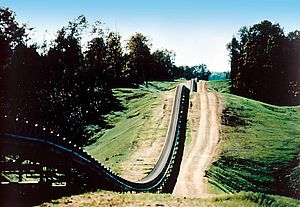
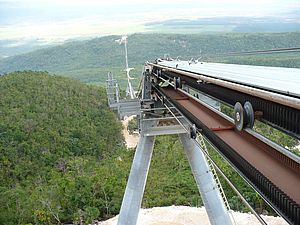
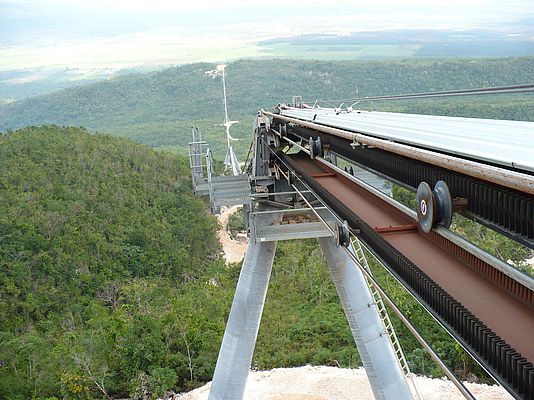
In many cases, it is possible to generate electricity from downward conveyance. One example is in Jamaica, where a conveyor belt system transports 1,200 tonnes of bauxite over a distance of 3.4 km and a drop in altitude of 470 meters. The braking force is converted into an electrical output of 1,300 kW – in three hours, as much energy is generated as the average four-person household in Germany consumes in a year. In addition to this, the system meant it was no longer necessary to build new roads. It replaces 1,200 truck journeys each day, as well as the associated fuel consumption and CO2 and fine particle emissions that entails.
Sustainable business operations
"At ContiTech, we're not just interested in extracting wealth from the ground," say Hans-Jürgen Duensing. "We also want to protect nature and the world's climate. Our business activities are therefore oriented towards sustainable solutions. We are motivated by people's need for quality of life and secure supply around the world. We're therefore investigating and researching answers to the social and economic issues of the future – and we find these answers. For example, by creating the necessary conditions for extracting raw materials in a climate and environmentally-friendly way."