
IEN WebMag May 2026Issue #209 - 28/04/2026
IEN Europe presents Industry News, Products and Solutions for industrial decision makers in the pan-European B2B market.
Quick access
Contents2 Industry News: EtherCAT Technology Group | Fraunhofer ISST, Fujitsu Research3 Industry News: Deutsche Messe | ABB, Rittal4 Industry News: ifm | CAN in Automation | Delta & Centrica5 Automation: An Open Architecture for Utilising All Industrial Data6 Fandis (Advertisement)7 Automation: Continuous Firmware Monitoring8 Automation: Advantech | ILGE9 Maintenance: Repair or Replace: A Maintenance Manager’s Guide to Making the Right Compressor Decision10 Combining 3D Digital Imaging with Thermography for Stress Analysis11 Labfacility (Advertisement)12 Sensor, Test & Measurement: e+e Elektronik | HBK | TURCK13 Sensors, Test & Measurement: LIKA | ifm | Beckhoff14 Motors & Drives: Unlocking Easier Automation15 Motors & Drives: Alva Industries | Rodriguez16 Motors & Drives: Fast, Repeatable, and Safe Automated Cutting17 Electricity & Electronics: Exxelia | TDK Lambda18 Index19 Contacts20Companies in this issue
E+E Elektronik Ges.m.b.H.13 Fandis S.p.A.7 Hans Turck GmbH & Co. KG13 Inovance Technology Deutschland GmbH17 Lika Electronic Srl14 Rodriguez GmbH16ADVANTECH Europe BV9 Alva Industries16 Beckhoff Automation GmbH14 E+E Elektronik Ges.m.b.H.13 ELGi Compressors10 Exxelia18 Fandis S.p.A.7 Hans Turck GmbH & Co. KG13 Hottinger Brüel & Kjaer GmbH13 ifm electronic gmbh14 ILGE AI9 Inductive Automation6 InfraTec GmbH Infrarotsensorik und Messtechnik11 Inovance Technology Deutschland GmbH17


#2 Contents
#3 Industry News: EtherCAT Technology Group | Fraunhofer ISST, Fujitsu Research
#4 Industry News: Deutsche Messe | ABB, Rittal
#5 Industry News: ifm | CAN in Automation | Delta & Centrica
#6 Automation: An Open Architecture for Utilising All Industrial Data
#7 Fandis (Advertisement)
#8 Automation: Continuous Firmware Monitoring
#9 Automation: Advantech | ILGE
#10 Maintenance: Repair or Replace: A Maintenance Manager’s Guide to Making the Right Compressor Decision
#11 Combining 3D Digital Imaging with Thermography for Stress Analysis
#12 Labfacility (Advertisement)
#13 Sensor, Test & Measurement: e+e Elektronik | HBK | TURCK
#14 Sensors, Test & Measurement: LIKA | ifm | Beckhoff
#15 Motors & Drives: Unlocking Easier Automation
#16 Motors & Drives: Alva Industries | Rodriguez
#17 Motors & Drives: Fast, Repeatable, and Safe Automated Cutting
#18 Electricity & Electronics: Exxelia | TDK Lambda
#19 Index
#20 Contacts
UL Solutions Certifies EtherCAT's Cyber Resilience
UL certificates confirm the EtherCAT Technology Group’s assessment and demonstrate that EtherCAT meets IEC 62443 / CRA requirements for Security Level 2 without modifications

The report and certificates from UL Solutions, following testing in accordance with IEC 62443, confirm the ETG’s statements: EtherCAT technology already meets the requirements for systems exposed to cyber attacks corresponding to Security Level 2 without any modifications. In its European version IEC 62443, the international standard for cyber security of industrial control systems, will also form the basis for the European Cyber Resilience Act. Furthermore, the investigations show that no hardware changes are necessary for higher security requirements. With targeted software enhancements, higher security levels can also be achieved based on the EtherCAT system.
Evaluation of different scenarios
UL mapped all 100+ System Requirements (SR) of IEC 62443-3-3 to three typical EtherCAT systems with different threat scenarios and evaluated the degree of compliance achieved by EtherCAT.
“We at UL Solutions were delighted to work with an industrial protocol which has security capabilities and enablement-by-design as well as hardware implemented security, which is second-to-none in the category of industrial protocols”, says Alexander W. Koehler, S&S Principal Security Advisor for Cybersecurity at UL Solutions. “IT and OT-security have not been best friends in the past. IT security requirements have often been driven by typical short product lifecycles of office worker equipment, which contrast with industrial equipment with long lifecycles. In consequence there are still many products in the industrial field without or weak security built in, labelled as legacy products. EtherCAT is a positive exception here.”
Dr. Guido Beckmann, Chair of the Technical Committee of the EtherCAT Technology Group: “The results of the extensive investigations confirm the ETG’s assessment: EtherCAT already provides a high level of cyber security protection for industrial applications today. The tested and documented features and measures form the basis for the recommendations and specifications we are developing for manufacturers and users of EtherCAT devices.”
Removing Corporate Data from AI Models
The development of AI models in joint projects yields improved results because multiple companies contribute their data. The situation becomes critical, however, if a partner withdraws and requests the return of its data. With federated unlearning, Fraunhofer researchers and Fujitsu Research have developed a method for precisely removing data from decentralized AI models.

If multiple collaborating companies feed data into an AI, the learning model will contain an especially wide variety of data. This improves the quality and reliability of the results it generates. Companies rely on federated, decentralized training approaches to retain data sovereignty. In this approach, the data is not sent to a central server. Instead, it is fed into a local copy of the AI model. The partners then exchange only abstract parameters rather than the actual data. This enables each partner to provide data to the AI without having to disclose it to the other companies.
But there is still a problem: When a company leaves the collaborative project, its data and parameters still remain deeply embedded in the AI model. It has previously been nearly impossible to extract this data from the “black box” of the AI without compromising the quality of the results, such as in predictions or simulations.
A clean sweep
In collaboration with industrial partner Fujitsu Research, the Fraunhofer Institute for Software and Systems Engineering ISST in Dortmund has developed a solution: unlearning for decentralized, federated AI collaborative projects. This method goes back through the history of the step-by-step AI learning process to the point where the relevant partner introduced its data. AI training resumes from this point—only without the data from the partner who has withdrawn. This method ensures a clean sweep of the AI, removing all the information and data from the company leaving the collaboration. Retraining the model with the stored parameters is also more efficient than the first time through.
Fraunhofer ISST research scientist Florian Zimmer explains: “The learning model isn't rebuilt all the way back from zero with the remaining partners’ data. Relatively little effort is thus needed to restore the performance and integrity of the AI. Depending on the application, a certain loss in the quality of the results is unavoidable due to the removal of part of the data, but this is compensated for by further AI learning as time goes on.”
Learning and unlearning in practice
A possible application for AI based on federated learning and unlearning methods is the use of machines in the manufacturing industry. For example, if multiple companies use the same model of a milling machine in different ways, different data is also introduced to train the AI. For example, one partner may provide data accounting for failure of the machine's motor, and another for breakage of the milling head.
In practical operation, the AI can thus simulate in advance when the motor will threaten to overheat or when a milling head will reach its load limit. This benefits all participating companies. Janosch Haber from project partner Fujitsu Research says: “For previous training approaches, the departure of a partner in cases like this would mean that the developed model would have to be completely retrained. Before the rebuild, the quality of the AI simulation would be severely impaired at first—no matter how important the departing partner's data was. Unlearning largely prevents this loss of quality, quickly and efficiently restoring a high-quality simulation model. In general, the departure of a partner hardly has any negative impact.”
Promoting greater use of AI
The federated unlearning method for decentralized AI models developed by Fraunhofer ISST and Fujitsu Research allows companies to engage in collaborative projects without reservations. They can draw on the enormous potential of AI to very efficiently develop high-quality solutions. At the same time, they can rest assured of their ability to withdraw from the collaborative project without having to leave behind their own proprietary data. This also benefits companies who are required to handle data in compliance with regulatory conditions such as the General Data Protection Regulation (GDPR).
“Our approach could noticeably increase the use of AI in corporate networks and partnerships. This will also benefit the industry as a whole and technological sovereignty in Germany and in Europe,” states Zimmer with conviction.
HERMES AWARD 2026 Goes to Schaeffler
The industrial group receives this coveted innovation prize in recognition of its platform for highly integrated actuators. An independent jury chaired by Prof. Dr.-Ing. Holger Hanselka, President of the Fraunhofer Society, selected the winner from among three nominated companies. The award was presented by Dorothee Bär, Federal Minister for Research, Technology and Space, during the official opening of HANNOVER MESSE on April 19, 2026, in the presence of Federal Chancellor Friedrich Merz.

The award honors a platform for highly integrated actuators, designed especially for use in the articulation joints of humanoid robots. The platform includes high-efficiency servo electric motors with integrated power electronics and encoders, and can be configured with two-stage planetary gear units or shaft-mounted gear units, depending on the customer's requirements. Throughout the development of the actuators, the overriding objective was to achieve minimum installation space while delivering high continuous torque. The installation footprint has been reduced by approximately 20 percent compared to the latest solutions currently on the market.
The copper fill factor in the frameless PSM machine was increased to ensure a low temperature level at high torques. The actuator platform significantly reduces system costs, thereby creating a key prerequisite for the rapid scaling of service robotics.
"My sincere congratulations to this year's award winners. As patron of the HERMES AWARD, I am delighted to help raise the visibility of cutting-edge innovations. The firms Schaeffler and BTRY demonstrate that Europe performs world-class research. With its innovative platform for highly integrated actuators, Schaeffler is enhancing robotics in Germany. The platform is a key component in helping robotics develop its vast potential in an excellent ecosystem that involves goods production and a strong industrial sector. We want to leverage such potential with our High-Tech Agenda Germany. At the same time, it is about technology made in Europe,” said Dorothee Bär.
Startup award for fully flexible battery
The coveted HERMES Startup Award goes to a young Swiss company. The startup impressed the jury with the ultra-thin, fully flexible solid-state batteries they have developed.
The product in question is an outstanding innovation in the form of ultra-thin solid-state batteries. These combine fast charging, high temperature resistance, and an exceptional level of safety; indeed, they outperform conventional lithium-ion cells on all these counts. By applying production technologies from the semiconductor industry to battery manufacturing, BTRY has achieved a groundbreaking advance in the global shift toward smaller, safer, and more durable energy storage solutions – paving the way for the next generation of smart devices. These include wireless IoT sensors, wearables, and applications in the field of medical technology. The production process is entirely free of toxic solvents and is characterized by low material consumption. These batteries can operate at temperatures of up to 150 °C and, with a thickness starting at just 0.1 mm, can be fully charged and discharged within one minute.
Technology Partnership for the Power Distribution of the Future
Making electrical infrastructure fit for future challenges with greater safety and speed – that is the goal of the new technology partnership between ABB and Rittal. Working together to create innovations for the European and international market will significantly accelerate the development and expansion of electrical infrastructure.

The partnership brings together two global technology leaders in their respective domains for joint developments: ABB as an innovative manufacturer of intelligent, networked and secure power supplies, and Rittal as a leading supplier of switchgear system technology and power distribution platforms. With 75% faster assembly and an innovative platform approach, Rittal’s RiLineX busbar system sets the new standard for power distribution – further driven by a growing ecosystem of tried-and-tested technology partners.
"We are delighted to be transforming our long-standing collaboration with ABB in the field of uninterruptible power supply for data centres and switchgear and control technology for power distribution into a global technology partnership. We will be expanding our RiLineX and Ri4Power platforms with joint innovations in the future," says Uwe Scharf, Managing Director Sales Germany and Europe at Rittal.
"This partnership combines advanced low-voltage technology and proven power distribution platforms to deliver superior results for panel builders," said Piero-Giorgio Schiannini, Head of Smart Power & Smart Buildings Sales and Marketing, ABB Electrification. "Seamless compatibility between ABB solutions like Tmax XT and Rittal's Ri4Power systems creates a better customer experience—one that reduces complexity, shortens project timelines, and ensures reliable performance."
Growth in Turbulent Economic Times
The ifm group has announced its financial results for the successful 2025 fiscal year.

The ifm group ended 2025 on a very positive note. Sales, adjusted for currency effects, increased by 10% to EUR 1.47 billion. “This very positive result for 2025 is particularly remarkable as we were able to achieve strong growth worldwide despite ongoing geopolitical challenges – almost exactly in line with our plans,” says Christoph von Rosenberg, CFO of the ifm Group. While demand in the German market declined, caused in particular by the weak order situation in the mechanical engineering sector, this was more than offset by strong growth in the Asia-Pacific region and the Americas. Strong momentum came especially from the process industry, where a number of new products met with a very positive customer response and drove substantial growth in this segment.
Expanding sustainable construction capacities
Despite significant exchange rate effects, earnings before interest and taxes (EBIT) increased slightly by 1% compared to the previous year to reach EUR 69 million. The workforce grew to around 9,120 employees. More than 5,260 of these are based in Germany. The company’s innovative strength is clearly evident in the approximately 1,500 employees working in research and development.
Following the change of name to ifm group se on 1 January 2025, the investor KKR has held a minority stake since October 2025. Through this partnership, the family-owned business aims to secure future success and sustainable growth for the next generation. One of the highlights of the past year was the start of construction on a new plant in Suzhou, China, in April. Production at this sustainable production site, which complies with the DGNB Gold standard, is scheduled to begin in the first quarter of 2027. This will enable ifm not only to maintain its 20-year long sales presence in this important market, but also to reinforce its position through local production and R&D expertise. With these milestones, ifm sees itself very well positioned for the future and expects positive growth again in the current year.
CAN in Automation Board of Directors Re-Elected
The election took place at the General Assembly during the two-days event "CiA Member Days" in Freising, Germany

At the General Assembly of the CAN in Automation (CiA) nonprofit association the active board of directors has been confirmed: Magnus Hell (Infineon), Christian Schlegel (chs consulting), and Holger Zeltwanger (CiA Managing Director). Robert Bosch, esd electronics, emotas, MicroControl, and Texas Instruments were elected as the Technical Committee, chaired by Magnus Hell. esd electronics, emotas embedded communication, MicroControl, Texas Instruments, and Vector have voting rights in the Business Committee, chaired by Christian Schlegel.
The General Assembly took place during the two-days event "CiA Member Days" in Freising. The technical presentations on this event included such topics as "CAN and artificial intelligence," "CAN XL," "CANsec," "Ethernetification of CAN," and "48-V supply systems." Presentation slides are available for members to download from the CiA website.
Next year's General Assembly will take place on March 5 in Tutzing on Lake Starnberg (Germany), as part of the 19th international CAN Conference (iCC). This day also marks the 35th anniversary of the international CAN user association, which currently has over 700 members. CAN (Controller Area Network), first introduced in February 1986, is one of the most successful serial communication systems, with around four billion newly installed nodes per year. This number continues to grow.
Scalable Off-Grid Fuel Cell Power Solution for Data Centres and Mission-Critical Applications
Delta announced an infrastructure partnership with Centrica plc (Centrica) to serve the data centre market and energy intensive industries in the UK and Europe, launching with Solid Oxide Fuel Cells (SOFCs) for off-grid energy generation.

The partnership creates a pathway for offering customers competitively priced, on-site power generation, significantly reducing exposure to wholesale electricity market volatility and grid capacity constraints. The partners plan to establish a demonstration site in the UK within the next 12 months, with a medium-term goal of delivering MW-scale, rapidly deployable 'gas-to-power' solutions within the next three to five years. Delta’s SOFCs, licensed by British solid oxide technology leader Ceres, provide stable, low-carbon energy fuelled by natural gas and reach 60% electrical efficiency - significantly higher than the open-cycle gas turbines typically used for on-site and back up generation (35%-42%). These cells are designed to meet the growing power demands of data-intensive digital infrastructure in the UK and Europe which underpin economic growth, digital sovereignty and energy transition.
Commenting on the partnership, Charles Tsai, General Manager of Hydrogen Energy Business Development at Delta Electronics, said: “We chose to partner with Centrica because they share our commitment to delivering reliable, energy-efficient solutions for the rapidly expanding energy market in the UK and Europe. Centrica’s deep energy system expertise, strong local presence and innovative approach to off-grid and flexible power make them an ideal partner as we support both data centre operators and high energy-intensive industries that demand resilience, sustainability and operational excellence.”
Chris O’Shea, CEO of Centrica, added: “Businesses across the UK and Europe need more power, and they need it faster than the electricity grids can deliver. This partnership brings together Centrica’s energy expertise, Delta’s world class manufacturing and cutting edge fuel cell technology to meet this growing energy demand with fast, reliable off grid power at scale.”
This partnership enables Delta to expand its presence in the European energy infrastructure market while cementing Centrica’s leadership in the energy transition and giving customers access to cleaner, more resilient and lower cost power.
An Open Architecture for Utilising All Industrial Data
We spoke to Travis Cox (Chief Technology Evangelist, Inductive Automation). He has been with the company since 2004, connecting industry experts, promoting innovation and open standards, and showcasing the capabilities of the Ignition platform.
Automation, Industry 4.0

IEN Europe: Ignition is often described as more than a traditional SCADA platform. How would you define its role today within modern industrial architectures?
Travis Cox: Ignition has evolved well beyond traditional SCADA into what we describe as a universal industrial integration platform – one that unifies data across the entire OT/IT stack on a single codebase, from PLCs and field devices all the way to enterprise systems and the cloud. Asking whether Ignition is HMI, SCADA, or MES is a bit like asking what a smartphone is: it's all of those things and fundamentally more.
Its real role today is serving as the foundational integration platform for the entire industrial enterprise. Through its server-centric web-deployment model, Ignition can instantly deliver industrial applications to an unlimited number of users on virtually any device – whether that's a desktop workstation, an industrial display on the plant floor, or a mobile device in the field – without requiring separate builds or deployments for each. It acts as the Unified Namespace of the plant floor, providing a single, organized, real-time data layer where all systems – from field devices to business applications – can publish and consume a common source of truth. This removes data silos that have historically plagued industrial organizations and replaces them with a live, contextualized view of operations that gets into the right people's hands, wherever they are. For companies pursuing digital transformation, Ignition isn't just a tool in the stack – it's the foundation the stack is built on.
IEN Europe: Many manufacturers are moving toward unified IT/OT data environments. How does Ignition facilitate this convergence in practice?
Travis Cox: Ignition bridges the IT/OT gap by speaking both languages natively and without compromise. On the OT side, it connects to virtually any PLC, field device, or industrial protocol – including native device drivers, OPC UA, MQTT, and CESMII i3X – regardless of brand, model, or vendor. On the IT side, it integrates seamlessly with SQL databases, Kafka, REST APIs, and line-of-business applications, making it just as capable of connecting enterprise systems as it is plant floor equipment. This dual fluency means manufacturers don't have to choose between their operational infrastructure and their enterprise systems – Ignition ties them together into a single, contextualized data environment.
What makes this especially powerful in practice is that Ignition doesn't just move data – it contextualizes it. It provides history, alarms, and meaningful structure so that real-time production data becomes genuinely useful to the people and systems across the organization who need it. Engineers get visibility into process performance, IT teams get reliable data pipelines, and executives get dashboards that reflect what's actually happening on the floor. The result is that the traditional wall between production and IT doesn't just come down – it becomes irrelevant, because everyone is working from the same live, trusted data source.
IEN Europe: Ignition’s modular and open architecture is frequently highlighted as a key differentiator. What advantages does this bring for system integrators and industrial users?
Travis Cox: The modular architecture means integrators and end users can build exactly the system they need – and expand it incrementally over time without being locked into a rigid product structure or forced to pay for capabilities they don't use. Each module adds specific functionality, so organizations can start with a focused deployment and grow the platform as their needs evolve. But what truly sets Ignition apart as an iterative platform is how its unlimited licensing model reinforces this philosophy. With unlimited tags, clients, users, and device connections all included under a single flat-rate license, teams are never financially penalized for solving the next problem. There are no artificial ceilings that force a conversation about cost every time an engineer wants to add a new data source, extend visibility to another part of the plant, or bring a new group of users into the system. The platform actively encourages continuous improvement rather than constraining it.
Because Ignition is built on open, trusted technologies like Python, SQL, OPC UA, and MQTT, integrators can leverage existing skills and connect to virtually any system without proprietary constraints or vendor lock-in. The open module SDK and built-in REST API also makes it straightforward to integrate Ignition with new tools and technologies as they emerge – whether that's a new cloud analytics service, a new communication protocol, or an AI platform. This combination of modular flexibility, open architecture, and unlimited licensing creates a platform that organizations can keep coming back to as their needs evolve – iterating, expanding, and refining their systems over time without ever hitting a wall. For industrial users, that means the investment made on day one keeps compounding in value, because the platform grows with the organization rather than becoming a bottleneck the moment ambitions outpace the original deployment.
IEN Europe: Industrial companies are increasingly deploying applications at the edge while connecting to enterprise systems and the cloud. How does Ignition support this distributed architecture?
Travis Cox: Ignition was designed with exactly this kind of distributed, multi-tier architecture in mind, and it addresses each layer with a purpose-built edition that works seamlessly with the others. At the far edge, Ignition Edge extends the platform to field devices and OEM equipment, enabling local data collection, visualization, and data syncing – even in environments with limited connectivity or compute resources. This means intelligence and visibility can exist right where the data is generated, rather than depending on a constant connection back to a central system.
At the plant level, standard Ignition serves as the central hub, aggregating data from all edge nodes, providing context and history, and making that data available to operators and applications across the facility. Then, Ignition Cloud Edition extends the architecture further, leveraging elastic infrastructure on platforms like AWS and Azure to provide enterprise-wide dashboards, long-term data storage, and integration with advanced analytics and machine learning services – all on a flexible, pay-as-you-go model. What makes this architecture particularly compelling is that all three tiers – edge, plant, and cloud – run on the same Ignition platform with a consistent development experience and a unified data model. There's no fragmentation, no translation layers, and no separate tools to maintain at each level.
IEN Europe: Cybersecurity and scalability are key concerns for industrial operators. What design principles within Ignition help address these challenges?
Travis Cox: On the security side, Ignition is built on a unified, industrial-grade security architecture that takes a defense-in-depth approach. It supports TLS 1.2 and 1.3 encryption for all communications – the same standard trusted by financial institutions worldwide – along with federated identity, MFA, SSO, SAML, and OpenID Connect integration. Role-based access control and security zones give operators granular control over who can access what and from where, whether they're on the plant floor or connecting remotely. Secrets management removes passwords and encryption keys from gateway configuration, adding another layer of protection for sensitive credentials. Built-in user auditing provides administrators with detailed visibility into system activity, helping teams quickly identify and respond to anomalies before they become costly incidents. Inductive Automation also backs this up at the organizational level, holding ISA/IEC 62443-4-1 certification for their secure software development lifecycle and maintaining ISO 9001 compliance.
On scalability, Ignition takes an equally principled approach – one that starts with the licensing model itself. Rather than charging per tag, per client, or per user, Ignition uses a flat-rate server license that removes the artificial constraints that typically limit growth in traditional SCADA systems. Organizations can add unlimited tags, connect unlimited devices, and deploy to unlimited clients without triggering additional licensing costs. This aligns the platform's economics with the organization's ambitions rather than working against them. Combined with the ability to deploy on-premise, at the edge, or in the cloud – and to scale cloud instances elastically up or down as demand changes – Ignition gives industrial operators a platform that grows with them without financial penalty or architectural rework.
IEN Europe: Looking ahead, how do you see SCADA and industrial software platforms evolving over the next five years, particularly with the rise of AI and data-driven manufacturing?
Travis Cox: The next five years will be defined by two parallel and reinforcing trends: deeper integration and intelligent automation. On the integration side, we'll see organizations move decisively toward Unified Namespace architectures – building rich, contextualized data models from the edge up, standardizing how data is structured and published, and connecting those data environments across plants, business units, and entire enterprises. The days of siloed SCADA systems that only talk to themselves are numbered. The organizations that move fastest on this integration foundation will be the ones best positioned to take advantage of what comes next.
What comes next is AI – and it will reshape industrial operations in two meaningful ways. The first is AI-assisted development, where engineers use AI tools to build, configure, and maintain Ignition applications faster and with fewer resources. The second, and arguably more transformative, is AI agents operating directly on live industrial data to perform tasks that today require significant human expertise: anomaly detection, predictive maintenance, root cause analysis, alarm rationalization, energy optimization, and process improvement. Inductive Automation is already moving in this direction, having released an early-preview MCP module for AI integration, with an ambition toward building full agent workflows directly into the platform. The industrial software platforms that win over the next five years won't just be the ones with the most features – they'll be the ones that serve as the trusted, open, and well-structured foundation on which Industrial AI can be reliably built and adopted.
IEN Europe: Thank you for these insights!

Continuous Firmware Monitoring Software
Minimising cyber risks and ensuring firmware security throughout the entire product lifecycle.
Automation

A critical component of the implementation of the Cyber Resilience Act (CRA) is the capacity of manufacturers to consistently monitor security risks throughout the entire lifecycle of a digital product, from development to post-shipment. Consequently, modern firmware monitoring technologies are becoming increasingly important.
The Düsseldorf-based cybersecurity company ONEKEY has developed digital twin technology that enables automated scans to monitor firmware around the clock. ONEKEY's monitoring system reanalyzes the firmware daily to ensure continuous security throughout its entire lifecycle. When new vulnerabilities arise, the constantly updated database and enhanced detection capabilities alert users to critical developments that could compromise a product’s security.
Firmware as a Critical Vulnerability
Firmware is the fundamental software layer of many technical systems, including industrial control systems, IoT devices, medical systems, and vehicle components. Security vulnerabilities at this level are particularly critical because they allow direct access to hardware functions and are often difficult to fix retroactively.
At the same time, modern devices contain a multitude of external software libraries, open-source components, and proprietary modules. Each of these components can introduce new security risks if new vulnerabilities are discovered after a product’s release.
"Manufacturers must know which software components are included in their products and which new vulnerabilities arise in order to react quickly and effectively protect their systems," explained Jan Wendenburg, CEO of ONEKEY.
Continuous Analysis Instead of One-Time Reviews
As part of a modern firmware monitoring approach, a product’s firmware is continuously monitored, not just analyzed once. The goal is to automatically detect emerging security vulnerabilities in software components and assess their impact on existing products.
First, a detailed analysis of the firmware is conducted to achieve this. This process identifies all the software components contained within the firmware and creates a structured software bill of materials (SBOM). Based on this information, dependencies within the software supply chain can be transparently mapped.
Next, the SBOM is continuously compared against global vulnerability databases. As soon as new security vulnerabilities are published, for example in an open-source library, it can automatically be determined whether an affected product contains the vulnerable component.
ONEKEY’s “CRA Fast Start” program provides continuous monitoring throughout the entire product lifecycle. This program enables manufacturers of connected devices, machines, and systems to rapidly and structurally assess compliance with the Cyber Resilience Act. The CRA Fast Start approach won the “Best in Show Award” at Embedded World 2026.
Digital Twins for Scalable Security Testing
One method of implementing this approach is through the use of digital twins. This involves creating a virtual representation of the firmware, enabling security analyses to be conducted independently of the physical hardware.
These digital models can be continuously monitored to provide an ongoing overview of a product’s security status. This gives manufacturers a centralized source of information for identifying and addressing security risks early on.
Automated Prioritization and Incident Management
Another key aspect of firmware monitoring is automated risk assessment. Not every vulnerability poses an immediate threat. What matters is whether the affected software component is in active use and which functions it impacts.
Therefore, ONEKEY’s platform analyzes contextual information, such as affected components, exploitability of the vulnerability, and potential system impact with firmware monitoring as one of its features. The result is a prioritized list of security issues that can be addressed in a targeted manner.
This information feeds directly into security incident response processes, helping Product Security Incident Response Teams (PSIRTs) deploy security updates more quickly and effectively.
New Requirements for Manufacturers
The Cyber Resilience Act represents a fundamental shift in security strategy for manufacturers of digital products. In future, security analyses must be conducted throughout a product’s entire lifecycle, from development to operation to end of life.
Firmware monitoring is essential for this process. It combines automated software analysis, continuous vulnerability monitoring, and structured security processes into an integrated security management system.
"With the increasing number of connected devices and the growing complexity of modern software architectures, daily vulnerability checks are crucial for regulatory compliance and security," said ONEKEY CEO Jan Wendenburg.
Customizable, Cabinet-Free HMI Solutions for Industrial Automation
IP65-protected solution for large machines and factory floors where operators need flexible visualization
Automation
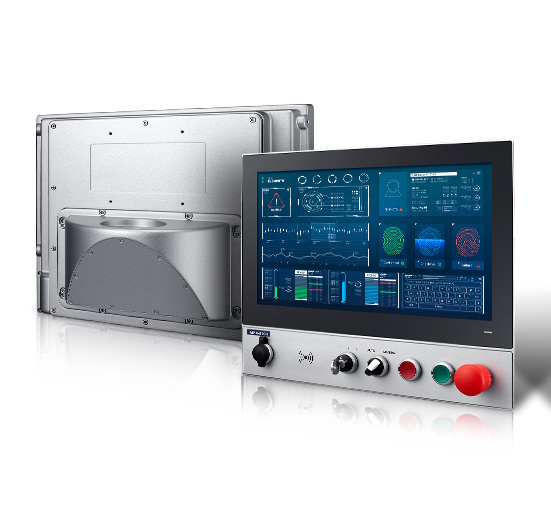
Advantech announced the release of its next-generation button-integrated HMI series — SPC-800 V2, featuring both Panel PC and Monitor versions. This series is designed to deliver greater flexibility, durability, and efficiency across heavy machinery, robotics, and automated production lines.
Building on customer feedback and the experience of the SPC-800 series in the field, the new SPC-800 V2 introduces major mechanical and operational advancements — including customizable front control panels, enhanced back-housing design for simplified cabling. The monitor version is equipped with HDBase-T 2.0 technology, enabling long-distance video transmission in large-scale industrial environments.
The 15.6"/21.5" FHD Display models offer 16:9 aspect ratio and P-CAP multi-touch control. The Panel PC versions are powered by Intel® Core™ 13th generation processors for high performance with up to 64GB memory capability of two DDR5 SODIMM. The rugged silicone-free enclosures are IP65 protected for reliable operation in harsh environments and offer flexible mounting options.
Designed for Flexibility
To adapt optimally to the needs of each machine, both panel PC and monitor, offers a fully customizable front control panel. This ranges from visual adaptations and logos to various operational elements such as emergency stops, illuminated ring keys, RFID scanners, and push buttons in different colors. This flexibility empowers machine builders, system integrators and manufacturers to design operational interfaces that fit specific workflows, ensuring ergonomic, safe, and efficient machine control.
Simplified Cabling and Flexible Mounting
Redesigned with an improved rear housing structure, SPC-800 V2 simplifies cable routing, easy terminal block access and maintenance to reduce setup time and improve serviceability. Its expanded wiring compartment supports direct terminal connections while maintaining full IP65 protection. Supporting VESA, pole, arm, and ceiling mounts, as well as Rittal CP40 and Bernstein CS-480 B.Flex standards, it enables effortless integration into diverse equipment layouts and space-constrained environments.
Long-Distance and High-Reliability Operating Communication
For large-scale production lines, the SPC-821/815 (M) V2 monitor integrates HDBase-T 2.0 technology to enable 100-meter signal transmission with 4K/8K ESD protection. This innovation enhances system communication, supports daisy-chain applications, and reduces downtime by allowing quick monitor replacement without replacing the entire control unit. It is ideal for large machines and factory floors where operators need flexible visualization access.
The panel PC series, SPC-821/815, and the monitor series, SPC-821/815 (M) V2, are available now.
AI-Powered Visual Inspection System
For industrial quality control and defect detection
Automation, Vision & Identification

Developed by ILGE AI INC., GOZLE is an advanced visual inspection solution that leverages artificial intelligence and industrial imaging to detect product defects in real time. Engineered for demanding industrial environments, GOZLE eliminates subjectivity and fatigue-related errors associated with manual inspection, while ensuring consistent product quality. The system features high-resolution industrial cameras, real-time image processing, and deep learning-based classification models. GOZLE is capable of detecting surface defects, dimensional errors, color mismatches, label misplacements, and other nonconformities on fast-moving production lines.
With its modular and scalable architecture, GOZLE can be integrated directly into conveyors or used as a standalone quality station. The intuitive user interface allows non-programmers to define inspection rules and train the system on new product types quickly. In multi-camera setups, the system captures various angles to ensure full visual coverage and reliability in detection.
Inspection of up to 100 parts/minute
The system supports seamless integration with MES/ERP systems, providing instant defect reports, inspection logs, and traceability data. It can also trigger automated reject mechanisms or stop signals in case of critical faults. With its ability to inspect up to 100 parts per minute depending on application complexity, the system improves production throughput and reduces rework costs.
Repair or Replace: A Maintenance Manager’s Guide to Making the Right Compressor Decision
Part 2: Selecting the Right Replacement Compressor. Author: Rodrigo Varela, Senior Director – Aftermarket, ElGi
Industrial Equipment & Supplies

This is the second part of the article, which looks at the criteria to consider when choosing the right compressor. You can find Part 1, which is designed to help you decide whether to repair or replace, here: https://www.ien.eu/bingo/66726.
If analysis indicates replacement as the optimal path, the following factors become essential to selecting the appropriate new system:
Air Demand Precision: Matching Tool and Process Requirements
Begin with a comprehensive assessment of your actual compressed air requirements. Measure both flow (CFM/m³/min) and pressure (PSI/bar) demands across different operational scenarios. Include peak demands, average consumption, and minimum requirements. This data prevents both over-specification (wasting capital and increasing ongoing energy costs) and under-specification (leading to performance issues and premature replacement).
Modern audit equipment can log demand patterns over extended periods, revealing actual usage profiles rather than relying on theoretical calculations. This empirical data forms the foundation for selecting appropriately sized equipment that matches your precise operational needs.
Compressor Technology Selection: Finding the Right Fit
Different compressor technologies offer distinct advantages for specific applications. Rotary screw compressors provide reliable, continuous operation for industrial applications. Piston compressors suit intermittent use with higher pressure requirements. Centrifugal compressors excel in high-volume, constant-demand environments, while scroll compressors offer oil-free air for sensitive applications at lower volumes.
Evaluate which technology aligns with your operational profile, considering factors like duty cycle, pressure requirements, and air purity needs. The optimal technology selection delivers the required performance while minimising energy consumption and maintenance requirements.
Compressed Air Quality Requirements: Meeting Application Standards
Different processes require different compressed air quality levels. Electronics manufacturing, pharmaceutical production, and food processing typically demand oil-free compressed air (ISO 8573-1 Class 0), while general manufacturing may tolerate standard lubricated compressors with appropriate filtration.
Determine the compressed air purity requirements for your most sensitive applications, considering particulates, moisture, and oil content specifications. Selecting a compressor that inherently meets these requirements may prove more economical than adding extensive downstream purification equipment to a less expensive but less suitable compressor.
Power Infrastructure Compatibility: Ensuring Seamless Integration
Verify that your electrical infrastructure can support your preferred compressor configuration. Check voltage requirements, phase specifications, and starting current demands against your facility's capabilities. Upgrading electrical infrastructure adds significant cost to compressor replacement projects and may impact project viability.
For larger installations, evaluate potential harmonic issues with variable speed drives and confirm that your power supply quality meets the manufacturer's specifications. Proper electrical matching prevents damage to both the compressor and other equipment sharing the same power infrastructure.
Environmental and Acoustical Considerations: Location Matters
The operating environment significantly impacts compressor performance and lifespan. Evaluate temperature ranges, dust levels, and available ventilation at the installation location. Compressors require adequate cooling air and proper ventilation to function efficiently and reliably. Noise constraints may necessitate acoustic enclosures or remote installation locations. If noise reduction is important, compare sound levels (dBA) between models and calculate the cost-benefit of quieter operation versus other features. Remember that ventilation requirements may increase with acoustic enclosures, potentially requiring additional ductwork or cooling provisions.
Air Storage Requirements: Balancing Demand Fluctuations
Properly sized receiver tanks stabilise system pressure and reduce compressor cycling. Determine appropriate air storage capacity based on demand patterns, particularly in applications with high peak demands or rapid fluctuations. Adequate storage can permit smaller compressor specifications by managing short-duration peak demands through accumulated reserve.
Consider both the physical space available for storage and the pressure requirements of your processes when specifying receiver tanks. Multiple smaller tanks strategically placed throughout distribution systems often prove more effective than a single large tank, particularly in extensive installations.
Energy Efficiency Technologies: Maximising Return on Investment
Variable speed drives (VSDs) offer significant energy savings in applications with fluctuating demand by adjusting motor speed to match actual requirements. Heat recovery systems can capture up to 90% of input energy for factory space heating or process water warming. Sequence controllers optimise multiple compressor installations, ensuring the most efficient combination operates based on demand.
Calculate the payback period for these efficiency technologies based on your operating profile, energy costs, and utilisation patterns. While they increase initial investment, they often deliver the most substantial lifecycle cost reductions, particularly in high-usage applications.
Space Utilisation: The Footprint Factor
Modern compressors typically offer smaller footprints than older equivalents, potentially freeing valuable production space. Evaluate installation space requirements including maintenance access, ventilation clearances, and service points. Remember that ancillary equipment like dryers, filters, and receivers requires additional space beyond the compressor footprint.
Consider vertical configurations where floor space is limited, but confirm adequate ceiling clearance and lifting capabilities for installation and maintenance. The smallest footprint may not represent the optimal solution if it compromises serviceability or cooling efficiency.
Total Cost of Ownership: Beyond the Purchase Price
Evaluate prospective compressors based on lifecycle costs rather than initial price. Calculate energy consumption over the anticipated ownership period, typical maintenance expenses, and expected reliability based on warranty terms and service intervals. Longer warranties often signal manufacturer confidence in reliability, potentially indicating lower lifecycle costs despite higher initial investment.
Request references from existing users with similar applications to verify real-world performance and reliability. Manufacturer claims should be substantiated through case studies or testimonials from comparable operations, providing confidence in projected operation costs.
Serviceability: Ensuring Long-Term Support
Assess the ease of routine maintenance and the availability of qualified service providers in your region. Some manufacturers offer comprehensive service packages with guaranteed response times and predictable costs, while others rely on third-party service networks with varying capabilities and availability.
Evaluate parts availability, service intervals, and maintenance requirements against your internal capabilities. A slightly more expensive compressor with better service support and parts availability may prove more economical over its lifespan than a less expensive unit with limited support infrastructure.
The Crucial Compressed Air Audit
Before finalising any replacement decision, conduct a comprehensive compressed air audit. This evaluation should analyse current usage patterns, identify leaks in the distribution system, assess air quality requirements, and determine actual pressure needs at point-of-use.
Professional audits often reveal opportunities to reduce demand through leak repair, pressure optimisation, or inappropriate uses elimination. Addressing these issues before sizing a new compressor often permits smaller, less expensive equipment while improving overall system efficiency. Many compressor manufacturers offer audit services, providing valuable insights before significant capital commitment.
Conclusion
The repair-or-replace decision represents a significant investment consideration with long-term operational implications. By methodically evaluating the factors outlined in this article, maintenance managers can make informed decisions that optimise both immediate operational needs and long-term financial performance.
Remember that compressed air systems typically operate for 10-15 years, making this decision one that impacts operations for over a decade. Prioritise thorough analysis over rushed judgments, considering both immediate costs and long-term implications. The optimal decision balances financial prudence with operational reliability, ensuring your compressed air system remains an asset rather than a liability in your production environment.
Combining 3D Digital Imaging with Thermography for Stress Analysis
Combining 3D Digital Imaging with Thermography for Stress Analysis
Electronics & Electricity, Sensor Technology, Test & Measurement

Modern electronic circuit boards and electronic components enable ever-increasing data transfer volumes and faster processing speeds. As a result, power consumption and heat generation often increase, which frequently leads to warping of the mounting board. In addition, many electronic devices using these components are exposed to changing environmental conditions, which can cause connection failures due to deformation of the mounting board and similar effects. Researchers at ESPEC CORP., Japan, have developed a combined method of 3D digital image measurement (DIC) and thermography to measure thermal stress-induced deformation of components as early as the design phase.
At ESPEC, tests on the deformation of mounting plates for electronic components were previously carried out in a thermostatic chamber. The infrared camera recorded the temperatures through a measurement window in the chamber. In the past, this repeatedly led to problems such as condensation and frost formation on the window glass and the heat exchanger. This resulted in a deterioration of measurement accuracy and restrictions in the field of view. Furthermore, thermographic measurements through the window of the thermostatic chamber required a special window material, such as germanium or sapphire, that was transparent to long-wave IR radiation.
Verification and validation of the measurement method
To avoid the aforementioned problems, the researchers developed a new method that uses a doorless (open) chamber in which the sample is tempered with targeted air flow. The internal temperature can be kept at a constant level over a longer period by means of an "air curtain" at the inlet of the chamber, even at very low temperatures. The sample, which was attached to a substrate, was placed in the thermostatic chamber in such a way that the supplied air flowed evenly around both sides of the substrate, thus tempering it. For the measurements, the temperature was varied from -30 °C to +140 °C in 10 °C increments.
To verify and validate the suitability of the test conditions, the researchers used a VarioCAM® HD head 780 from InfraTec. This infrared camera was selected because of its geometric resolution, an image format of (1,280 x 960) IR pixels, and its good display capabilities for the extended test pattern. It was confirmed that the method enables precise measurements across the entire temperature range in a doorless chamber and without special window materials.
Measurement of Thermal Deformation
The three-dimensional expansion of the printed circuit board (PCB) at -30 °C served as a reference for the deformation tests. Parts of the PCB that deformed at higher temperatures were shown in red (deflection away from the substrate) or blue (deflection toward the substrate). These digital image measurements were superimposed on the images of the temperature distribution on the surface of the circuit board in operation.
It was observed that as the air temperature increased, a temperature difference occurred between the CPU and the surrounding PCB, and that the center of the CPU deformed toward the substrate. Based on this observation, the researchers concluded that it is important to measure the degree of deformation of each individual electronic component at different ambient temperatures rather than just that of the entire circuit board.
The study also shows that 3D digital image measurement and thermographic temperature measurement must be performed in parallel. The use of the doorless chamber, in which there is no barrier between the cameras and the sample, allows precise conclusions to be drawn about the deformation of the PCB under thermal stress of the sample.

Air/Gas Velocity Sensor for Industrial Applications
For easy installation with high accuracy and repeatability for safe processes
Sensor Technology
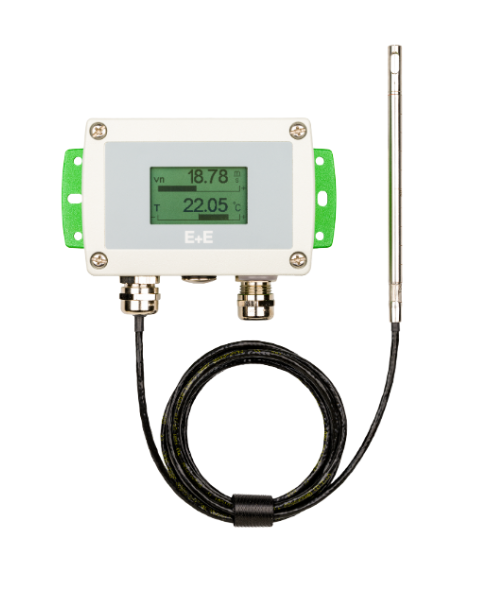
Developed and designed for demanding industrial applications, the new AVS701 from E+E Elektronik sets a new standard in air and gas velocity measurement. The optically and technically redesigned air and gas velocity sensor stands out above all for its accuracy and reliability, as well as significantly simplified installation. It is optimised for demanding industrial applications in a measuring range from 0 to 40 m/s and –40 to +140 °C and is suitable for a wide variety of uses – from cleanroom and pharmaceutical applications to process monitoring in 3D printers. Increased process efficiency and sensor installation that is up to 60% quicker make the AVS701 a good choice.
Thanks to the specially developed alignment crimp for the remote probe, the AVS701 can be positioned in the process with high repeatability. This enables fast, reproducible sensor mounting and quick sensor replacement, which speeds up commissioning and significantly increases efficiency.
Measurement accuracy for best product quality
The AVS701 impresses with exceptional measurement accuracy of ±1% of the measured value and, in the range from 0 to 2 m/s, even ±0.03 m/s. This level of precision ensures excellent process reliability, which is particularly crucial in sensitive applications such as cleanrooms and pharmaceutical production. Highly accurate monitoring of the air velocity optimises product quality and reduces scrap. Changes in the process can be detected more reliably and prevented at an early stage. In addition, the long-term stability of the AVS701 minimises maintenance intervals.
The AVS701 is equipped with a robust thin-film ceramic sensing element protected by a durable stainless steel probe head. A special coating on the sensing element protects it against moisture and corrosive influences such as hydrogen peroxide or ammonia. This makes the sensor particularly well suited for use in the most challenging environments, for example in the pharmaceutical sector or the chemical industry.
Wireless Gateway with 8 Analog Output Channels
Bridging wireless sensors and analog control systems
Sensor Technology, Test & Measurement

To help industries integrate sensor data directly into existing control, automation, and data acquisition systems, HBK has re-introduced the WSDA-101.
The WSDA-101 is a wireless gateway and is ideal for applications where predictable, low latency analog signals are required, such as structural health monitoring, equipment performance monitoring, PLC based system control, and environmental monitoring. By converting wireless sensor data into standard analog voltage outputs, the WSDA 101 enables engineers to use wireless measurements within established workflows that rely on PLCs, DAQs, and controllers. The WSDA 101 provides eight independently configurable analogue output channels, delivering 0–3 VDC signals that can be connected directly to equipment requiring standard analog voltage inputs. This approach allows wireless sensor data to be used in timing critical applications - including control loops, torque monitoring, and real time process feedback - without the need for custom hardware or complex system integration.
Lossless wireless communication
Designed for flexibility, the WSDA 101 can operate as a standalone device or in parallel with a host computer via USB, supporting both factory floor and PC based workflows. Configuration, monitoring, and data collection are managed using SensorConnect™ software, providing a straightforward setup process for engineers working in test, measurement, and automation environments.
In addition to analog output operation, the WSDA 101 supports LXRS® lossless wireless communication when the analog output mode is disabled. This enables reliable, high fidelity wireless data transmission across long distances for demanding measurement environments, such as spaces of up to 2 km in line-of-sight conditions. The base station supports multiple sampling modes, including synchronised and low duty cycle operation, and is engineered to deliver consistent performance in applications requiring deterministic behaviour. With its combination of wireless flexibility and direct analog output, the WSDA 101 is intended for engineers seeking a practical way to incorporate wireless sensor data into established industrial and laboratory systems without redesigning existing infrastructure.
Robust Flow Sensor with IO-Link
Measurement of flow and temperature with flexible configuration
Sensor Technology

TURCK is adding the FS501 flow sensor to its FS+ fluid sensor series. The robust IP67 device measures flow velocity and volume flow in liquid media and also outputs temperature values. Users can freely configure switching and analog outputs and benefit from easy integration into IO-Link environments thanks to Smart Sensor Profile. The FS501 is suitable for pipe diameters from 15 to 250 mm, covering a wide range of applications in factory automation.
The IO-Link interface according to Smart Sensor Profile enables access to process data and functions such as Single Value Teach for storing the current flow velocity as a switching point, Dynamic Teach, and Totalizer. In Dynamic Teach mode, the sensor automatically adjusts switching points to changing conditions. The Totalizer function can be used to determine consumption data for machines—directly in the sensor.
Modular Ultra Miniature Absolute Encoder
Magnetic measurements in space- and weight-critical applications, with axial or radial orientation
Sensor Technology

Lika Electronic's SMAR4 absolute modular encoder is remarkably small: the PCB readhead is one of the smallest on the market and measures only a few millimeters. The SMAR4 combines an open PCB readhead with the MRA and RMU magnetic rings with axial or radial magnetization in a very compact assembly. The through bore of the rings ranges from 8 to 70 mm. This design can be easily integrated into high-performance, space- and weight-critical applications such as robotic joints, robots and cobots, humanoids, surgical robots, electro-medical and laboratory devices, and OEM equipment.
SSI and BiSS Interfaces
The construction is frameless and bearingless; the measuring system is not equipped with a shaft, bearings, flange, and housing. Operation is contactless and no components are subject to wear or mechanical fatigue. The operating temperature ranges from -25°C to +100°C. The SMAR4 is equipped with SSI and BiSS C-Mode interfaces. It offers a resolution of up to 20 bits (1,048,576 cpr). In addition, up to seven encoders can be networked in a daisy-chain configuration.
Smart Condition Monitoring Made Easy
Monitoring the health status of devices without the need for expert knowledge
Automation, Motors & Drives, Sensor Technology

Smart condition monitoring based on vibration measurement makes it easier than ever to detect damage to centrifugal pumps, fans and electric motors at the earliest stages. This helps to prevent machine failures and enables cost-effective, demand-based maintenance planning. With the new features of moneo Asset Health, part of the moneo IIoT platform by ifm this type of condition monitoring can be implemented easily and on a scalable basis. No expert knowledge of vibration analysis is required. The system works seamlessly with ifm’s IO-Link-based VVB condition monitoring sensors, and the set-up of Asset Health is extremely simple.
Problems can be traced back to their causes
With just a few clicks, users can configure monitoring for a target machine such as a centrifugal pump, fan or electric motor. Like all features in moneo, Asset Health is also designed as a no-code solution, allowing users to set up and operate the system without any programming knowledge. Unlike conventional condition monitoring solutions, Asset Health does not simply detect a rising trend or anomaly; it also identifies the underlying cause of the fault. This is done automatically, without any complex threshold settings, opening up a wide range of possibilities: as soon as a problem is detected, the software automatically generates maintenance tickets detailing the respective damage pattern, the cause and a specific repair recommendation. With moneo Asset Health, maintenance teams gain access to a system that significantly simplifies their daily work, improves machine availability and can be seamlessly integrated into an existing maintenance strategy.
Industry-Ready Camera and Illumination Units
Complete vision solution for reduced installation effort
Automation, Vision & Identification

Beckhoff’s Vision Unit Illuminated (VUI) is a compact unit comprising a camera, illumination, and focusable optics complete with liquid lens technology. The series has now been expanded to include 16 devices with new image sensors as well as crossed polarizing filters.
Extended sensor range
The VUI is industry-ready and designed for the harsh day-to-day conditions of machine building, compact, robust, and engineered for easy integration into the control system. The extensive portfolio of units now includes 16 additional devices with new image sensors. With resolutions of 5.1, 8.1, and 12.4 MP, they are suitable for a wide range of demanding applications – from fast cycle detection to detailed quality inspection with elevated measurement and detection accuracy.
The devices are also available with crossed polarizing filters. This expands the range of applications, as the easy-to-use unit enables additional vision tasks to be solved by suppressing surface reflections. In this way, features can be captured with high contrast and without reflections, even through shiny transparent surfaces such as glass, plastic, and water.
Caption: The VUI vision series significantly reduces installation and commissioning effort, and has been expanded to include additional functions and 16 new devices.
Unlocking Easier Automation
As automation systems grow more complex, machine builders are rethinking how they design and deploy motion. Nicola Pezzolato, Application Engineering Leader EMEA at Kollmorgen, explores how a new generation of servo technology is helping manufacturers simplify design, improve flexibility, and build greater resilience into their supply chains.
Motors & Drives
When it comes to automation systems, complexity tends to grow faster than performance. Each new generation of machines promises higher precision, greater flexibility, and faster commissioning – but the reality is that these ambitions often translate into more wiring, more configuration, and more integration headaches. The result is a development cycle that’s harder to control, at a point when customers expect shorter lead times and lower costs.
That’s the challenge facing today’s machine builders. They’re under pressure to deliver high-performing systems in record time while navigating unpredictable supply chains, competing global standards, and shifting component availability. In that environment, the biggest advances don’t always come from adding new features or exotic capabilities, but from rethinking the fundamentals.
That shift involves three key ideas. The first is right-sizing: ensuring that systems include only the functions and features that add value, rather than paying for capabilities that will never be used. The second is openness: creating motion systems that can connect freely across different controllers, protocols, and markets without locking users into closed ecosystems. Finally, the third is resilience: designing equipment that can be built and supported reliably, even amid global uncertainty.
Together, these principles define a new approach to motion control; one where flexibility, reliability, and simplicity are not in conflict, but part of the same design philosophy.
The cost of unnecessary complexity
In the effort to design flexible machines, many OEMs end up over-specifying their motion systems. They select servo drives and motors packed with advanced features that have plenty of potential benefits in theory but, in practice, will never be used.
Now, the motivation behind this is very understandable. Buying the “top-end” option can seem like a safe hedge against future requirements and edge-cases.
However, this approach carries hidden (and, sometimes, not-so-hidden) costs. Each unused feature adds overheads in engineering effort, configuration time, and inventory management. Over-specified systems also tend to demand more from the control environment, all the way from safety validation to thermal management. Multiply that by dozens of axes, and the cost of complexity can become a serious drag on development efficiency and real-world usage.
In our experience, we’ve found that around 80% of applications only use a relatively basic set of essential features. As such, a more effective design strategy is to take a modular view of machine design – choosing motion components that deliver exactly the capabilities required for a given task, without the excess. That doesn’t mean compromising on performance; rather, it’s about applying the same precision we value in motion control to system design itself.
This “right-sizing” philosophy is gaining traction across the automation world. It’s reflected in the growing demand for servo platforms that can cover the majority of applications with standardized, streamlined options. By eliminating unnecessary features and focusing on what most users actually need, machine builders can simplify their engineering process and improve time to market, while still meeting demanding performance standards.
Open systems, not closed ecosystems
Many control platforms form what can only be described as closed ecosystems: the controller, drives, software, and even cabling are designed to work only with each other.
In theory, this ensures compatibility. In practice, however, it often creates inefficiencies. It ties machine builders to a single vendor, restricting flexibility and creating difficulties when supply issues arise or when a customer prefers a different PLC environment.
A more open, interoperable approach is now emerging, one that aims to give OEMs freedom without sacrificing reliability. Multi-protocol servo drives, for instance, can operate across EtherCAT, PROFINET, and EtherNet/IP networks through simple software configuration rather than hardware changes. This allows the same drive and motor platform to integrate with a wide range of controllers and fieldbus architectures, regardless of geography or customer preference.
For global machine builders, that’s a major advantage. A machine designed for one market can be deployed in another without reworking the control architecture or maintaining separate bills of materials for each protocol. This simplifies certification, reduces engineering overheads, and improves long-term serviceability.
Open systems also make it easier to mix and match technology partners. Drives and motors can come from one supplier, PLCs and HMIs from another. So long as everyone speaks the same “language” through standardized communication layers, they can work together effectively.
This not only helps to simplify set-up and avoid compatibility issues, it also helps OEMs build resilient systems and respond quickly when components are scarce or delayed – something that remains front-of-mind for many businesses after the disruptions we’ve seen over recent years.
Meeting modern expectations
For machine builders, the value of openness and simplicity goes beyond convenience. It enables better business decisions. When hardware can be deployed across multiple regions and control architectures, inventory management becomes easier. When drive systems are available from stock with predictable lead times, project planning becomes more reliable; and when software tools minimize the risk of setup errors, commissioning becomes faster and more consistent across teams and sites.
That’s why the industry is beginning to see a quiet shift in mindset. The old equation – more features = more capability – is giving way to something more nuanced. Enough features, applied intelligently, equals better outcomes.
Manufacturers like Kollmorgen have responded to this change by developing servo platforms built around the essential features most users need, rather than every feature that could be imagined. Systems like the Kollmorgen Essentials range reflect a pragmatic approach to automation: maintaining high-quality performance and global interoperability while trimming away unnecessary complexity.
The result isn’t a compromise, but rather a recalibration. It’s about recognizing that not every axis needs to be over-engineered, not every machine needs bespoke integration, and not every component needs to be tied to a single ecosystem.
The world of automation is advancing rapidly, and it’s easy to fall into the trap of thinking that the best way to meet the challenges of tomorrow is to jam every piece of technology possible into your system. However, the smartest progress often comes from simplifying rather than adding.
By focusing on openness, resilience, and right-sized design, machine builders can achieve faster development, lower cost, and greater confidence in their systems — even as the world around them becomes more complex.
Frameless Motor with Increased Torque
For compact direct-drive applications with high performance
Motors & Drives

Alva Industries announced the launch of SlimTorq™ STM-190-35, a new larger size in its SlimTorq™ frameless, slotless motor portfolio. The STM-190-35 expands the STM range with increased torque capability and precision, enabling demanding direct-drive applications where performance, compactness, and design flexibility are critical. Like all SlimTorq™ motors, the STM-190-35 is manufactured using Alva’s patented FiberPrinting™ technology, delivering ironless, slotless windings with high copper fill factor and zero cogging. The motor is available with multiple winding options, different terminal block designs, and optional temperature sensors and Hall sensors, supporting precise control and system-level optimization.
Performance and high precision in compact design
The STM-190-35 is designed for high-precision direct-drive systems such as electro-optical platforms, gimbals, robotics, and other motion-critical applications. With a favorable inner-to-outer diameter ratio and compact axial length, the motor supports space-efficient system designs without compromising torque density or control performance. To support system-level design and evaluation, the STM-190-35 is fully supported in Alva’s TorqStudio design and simulation platform. TorqStudio allows engineers to evaluate motor performance, explore winding options, and optimize motor selection early in the design process based on application-specific requirements. This new size gives system designers more freedom to optimize performance and mechanical integration, especially in direct-drive solutions where precision and smooth motion are essential.
The addition of the STM-190-35 brings the SlimTorq™ STM portfolio to nine available motor sizes, spanning different outer diameters and lengths. Each size can be configured with multiple inner diameter options, winding patterns, and custom configurations, allowing engineers to tailor the motor to their specific application requirements.
Profile Rail Guides in Optimized Design
Improved sealing and greater precision for mechanical engineering and robotics
Motors & Drives

Rodriguez offers the BRXH series of profile rail guides in an optimized design. The update comprises three key points: an enhanced lubrication concept, a new sealing system, and greater precision. This makes processes even safer while maintaining system compatibility. With the modifications to its BRXH profile rail guides, Rodriguez is responding to the increased demands in mechanical engineering and automation. The basic technical data remains unchanged, while targeted optimization measures improve process reliability and ensure longer service life and reproducible precision.
More lubrication points and new sealing concept
The guide carriages now have additional lubrication points, which distribute the lubricant better and more evenly within the recirculating ball unit. The systems are still delivered pre-lubricated. When lubricating from above, an adapter ensures targeted distribution in the carriage. A central element of the redesign is the new sealing system. Double lip seals on the front and double lip seals on the sides are used as standard, providing effective protection against particles and contamination. Additional variants are available as options: non-abrasive seals, additional abrasive seals, and metal wipers.
Higher accuracy becomes standard
The previous standard accuracy N is no longer available. Instead, class H becomes the new standard. The tolerances for height and width have been reduced by around 50 percent compared to the previous N version. Accuracy class P will only be available on request in future. Class Z2 is no longer available for preload; Z0, Z1, and Z3 remain available. Specifically, this means higher repeat accuracy – particularly relevant in robotics and automation – and better parallelism, i.e., multiple guides run more smoothly in parallel.
Further design modifications
In addition, the number of ground carriage surfaces has been increased from two to three. Cover caps made of plastic or, optionally, brass are available for the rails.
Some of the series' proven features remain unchanged, including the design with four rows of balls arranged in an X with a 45° contact angle to accept loads in all main directions, coating options, interchangeability within precision and preload classes, and availability in individual lengths of up to 3,900 mm.
Fast, Repeatable, and Safe Automated Cutting
Improved safety, faster changeovers with a new machine cutting machinen for cardboard cores with up to 1,250 mm diameter
Motors & Drives

Servo drives, motors, and PLCs from Inovance have enabled packaging machinery OEM Spiraltech to automate a machine capable of cutting cardboard cores from 60 mm up to 1,250 mm in diameter. The brand-new Edge 1250 has been developed by Spiraltech using Inovance technology from CAPSS, a UK-based distributor of industrial automation products. Thanks to the consistent, high-level of support from CAPSS and the high-performance products from Inovance, Spiraltech was able to provide an automated version of its cutting machine.
Cost-competitive, flexible and compact solution
Spiraltech wanted to replace its mechanical cardboard core cutting machine with a safer, more user-friendly automated version. The company was determined to retain a ‘good square cut’ even on large-scale jobs, while also seeking repeatability, ease of operation, and more efficient changeovers. In order to achieve those goals, it needed robust products for industrial settings and harsh environments, with high levels of accuracy and repeatability. The Edge 1250 was developed quickly and efficiently with technical support from CAPSS, and the new machine is able to utilise a hybrid system. It allows end-users to select either a saw blade or a knife blade, depending on the type of cut required.
Inovance products used in the Edge 1250 include a range of products including the AM500 PLC, GL 20 I/O modules, IS810N single and dual axis servo drives, the MD810 multidrive system and MS1 servo motors.
Key considerations when Spiraltech was selecting servo drives, motors and PLCs for the Edge 1250 included component size, strength, and cost competitiveness. The Inovance products are robust and compact without compromising performance, enabling more servo motors and servo drives to be used, delivering greater machine flexibility and automation.
Safer, faster, repeatable results
The Edge 1250 can cut cardboard cores of 60 mm up to 1,250 mm in diameter, making it suitable for a wide range of industries and applications; from theatrical set dressing and storing
fabric for designer chairs, to construction and steel processing. The Edge 1250 also has enhanced safety features, with operators protected from the blades, and changeovers made quicker, safer and easier through automation.
Spiraltech differentiates itself through innovative machine design, and its focus is on machines that can be changed over two to three times per day to enable small batch work. To achieve this, the machines have double the number of servos compared with leading competitors.
Steven Belwood, Managing Director of Spiraltech, says: “We have a really good existing relationship with CAPSS and excellent experiences with Inovance products, as they are compact, accurate, perform well, and are cost-competitive. We plan on working with Inovance and CAPSS again moving forward. This is the second big machine we have worked on with them, and it is performing well. It has been a pleasure to work with CAPSS and we look forward to using Inovance servos and motion products for more automation in the future.”
Paul Seale, Director of CAPSS, adds: “It was great to work with the Spiraltech team again, and we hope to build on the positive relationship and joint commitment to innovation moving forward. To be involved with a project that delivers above and beyond the brief is always a pleasure and the Edge 1250 is testament to what is achievable with industrial automation solutions.”
SMD High Voltage Mica Capacitors
Pulse and filtering capabilities in a compact package
Electronics & Electricity

The new Exxelia CM-HVLP series (High-Voltage Low-Profile Reconstituted Mica Capacitors) addresses growing demand for high-voltage, robust, and low-profile components in volume-constrained electronic systems. The new capacitors are engineered to meet the requirements of applications where high voltage handling, fast charge/discharge cycles, and reliability under repetitive stress are essential. Their design enables use in both pulse applications, such as charge and discharge circuits, and high-voltage filtering functions, offering a versatile solution for advanced electronic architectures.
The CM-HVLP series combines the intrinsic stability of reconstituted mica dielectric technology without any drift under voltage of the capacitance value and a breakthrough compact SMD footprint, supporting the ongoing miniaturization of high-power electronic systems. The capacitors provide high energy density, very low Equivalent Series Inductance (ESL), and the capability to withstand extreme dV/dt rates, enabling ultrafast discharge performance even under intensive repetitive cycles. The design is also optimized to propose low ESR value.
Extreme Reliability
Building on our demonstrated historical experience with Space QPL family lines, Exxelia is now extending this expertise to diversify markets (Defense, Space, New Space, Medical, Industry, Aviaton). To ensure mission-critical reliability, qualification tests are performed according to the most stringent MIL standards, e.g. on mechanical and thermal stress, to allow for long-term use.
Unmatched Miniaturization
Designed with integration in mind, the components feature a reduced footprint that facilitates placement in dense PCB layouts. The series offers a significant size advantage, with a format (8080) measuring only 20x20mm. This balance between miniaturization and power capability makes the technology particularly relevant for systems, where reliability and electrical stability are critical.
Fast Response ORing Modules
Rugged 60 and 80 Amp modules with efficiencies up to 99.5 %
Electronics & Electricity

TDK-Lambda introduces the i1R ORing FET modules, capable of operating at 60 or 80 A with a maximum input voltage of 60 Vdc. These ORing modules are designed to replace traditional diodes in applications that require ORing functionality for power supply redundancy or parallel operation. The i1R series uses MOSFET-based circuitry to provide a superior level of performance while reducing reverse current transients.
Compact metal packages
Applications for the i1R modules include communications, test and measurement equipment, plus harsh environment industrial and robotics requiring a high degree of shock and vibration. While the i1R series was designed to complement other TDK-Lambda solutions, including the i7A and i7C non-isolated converters, GQA and HQA industrial and defense COTS-grade isolated DC-DC converters, and RGF differential mode filter modules, its flexible architecture allows it to be deployed alongside other power solutions. The i1R series has a fast 500 ns (typ) turn-off response, blocking reverse current transients during fault conditions for better protection. The product has a typical low on-resistance of 2.5 and 1.5 mΩ, reducing power losses and waste heat, simplifying the thermal design. The product’s shielded metal package size is a compact 1 x 1” (26.3 x 26.3 mm), saving valuable board space and supporting efficient cooling. For added convenience and simplicity, the series operates without the need for any external components.
A
ADVANTECH Europe BV 9 Alva Industries 16B
Beckhoff Automation GmbH 14E
ELGi Compressors 10 Exxelia 18F
H
Hottinger Brüel & Kjaer GmbH 13I
ifm electronic gmbh 14 ILGE AI 9 Inductive Automation 6 InfraTec GmbH Infrarotsensorik und Messtechnik 11K
Kollmorgen Europe GmbH 15L
Labfacility Ltd 12R
T
TDK-LAMBDA Germany GmbH 18TIMGlobal Media BV
177 Chaussée de La Hulpe, Bte 20, 1170 Brussels, Belgium
o.erenberk@tim-europe.com - www.ien.eu
- Editorial Director:Orhan Erenberko.erenberk@tim-europe.com
- Editor:Kay Petermannk.Petermann@tim-europe.com
- Editorial Support / Energy Efficiency:Flavio Steinbachf.steinbach@tim-europe.com
- Associate Publisher:Marco Marangonim.marangoni@tim-europe.com
- Production & Order Administration:Francesca Lorinif.lorini@tim-europe.com
- Website & Newsletter:Marco Prinarim.prinari@tim-europe.com
- Marketing Manager:Marco Prinarim.prinari@tim-europe.com
- President:Orhan Erenberko.erenberk@tim-europe.com
Advertising Sales
Tel: +41 41 850 44 24
Tel: +32-(0)11-224397
Fax: +32-(0)11-224397
Tel: +32 (0) 2 318 67 37
Tel: +49-(0)9771-1779007
Tel: +39-02-7030 0088
Turkey
Tel: +90 (0) 212 366 02 76
Tel: +44 (0)7594 239 182
John Murphy
Tel: +1 616 682 4790
Fax: +1 616 682 4791
Incom Co. Ltd
Tel: +81-(0)3-3260-7871
Fax: +81-(0)3-3260-7833
Tel: +39(0)2-7030631
- IEN WebMag May 2026 IEN Europe presents Industry News, Products and Solutions for industrial decision makers in the pan-European B2B market.
- IEN WebMag May 2026 IEN Europe presents Industry News, Products and Solutions for industrial decision makers in the pan-European B2B market.
- IEN Europe WebMag February 2026 IEN Europe presents Industry News, Products and Solutions for industrial decision makers in the pan-European B2B market.
- IEN Europe WebMag January 2026 IEN Europe presents Industry News, Products and Solutions for industrial decision makers in the pan-European B2B market.
- WebMag IEN Europe December 2025 IEN Europe presents Industry News, Products and Solutions for industrial decision makers in the pan-European B2B market.
- WebMag August 2025 IEN Europe presents Industry News, Products and Solutions for industrial decision makers in the pan-European B2B market.
- WebMag July 2025 IEN Europe presents Industry News, Products and Solutions for industrial decision makers in the pan-European B2B market.
- WebMag May 2025 IEN Europe presents Industry News, Products and Solutions for industrial decision makers in the pan-European B2B market.
- WebMag February 2025 IEN Europe presents Industry News, Products and Solutions for industrial decision makers in the pan-European B2B market.
- WebMag January 2025 IEN Europe presents Industry News, Products and Solutions for industrial decision makers in the pan-European B2B market.
- WebMag December 2024 IEN Europe presents Industry News, Products and Solutions for industrial decision makers in the pan-European B2B market.
- IEN Europe SPS WebMag 2024 IEN Europe special issue for sps 2024 in Nuremberg, November 12 to 14.
- IEN Europe WebMag August 2024 IEN Europe presents Industry News, Products and Solutions for industrial decision makers in the pan-European B2B market.
- WebMag IEN Europe July 2024 IEN Europe presents Industry News, Products and Solutions for industrial decision makers in the pan-European B2B market.
- IEN Europe May 2024 IEN Europe presents Industry News, Products and Solutions for industrial decision makers in the pan-European B2B market.
- WebMag HANNOVER MESSE 2024 Special issue for Hannover Messe 2024, April 21 - 26
- WebMag January/February 2024 IEN Europe presents Industry News, Products and solutions for industrial decision makers in the pan-European B2B market.
- WebMag December 2023 Highlights Products and Solutions sps and from 2023
- IEN Europe November Webmag Special SPS As the industrial world gears up for the 2023 SPS Show in Nuremberg, attendees and exhibitors alike are eagerly awaiting the opportunity to delve into the latest trends and innovations that promise to reshape the future of industrial automation and techno
- IEN Europe April WebMag Throw an eye to this web magazine dedicated to the coming Hannover Messe 2023! We wish to see you there as well. Have a nice and interesting reading
- IEN Europe Jan/Feb 2023 Webmag Dear readers, Happy New Year to you! IEN Europe is coming back this new year with a special focus on robotics and digital automation.
- #6 AI IEN - December 2020 Discover our latest edition of our digital magazine: AI IEN!
- IEN Europe December Last issue of 2020, IEN Europe December highlights the key trends in the IoT & e-mobility, Automotive, and Identification & Vision Systems fields.
- IEN Europe November - SPS Webmag Discover in this digital issue the best technology showcased at the upcoming SPS virtual exhibition!
- #5 AI IEN - October 2020 We are delighted to release the fifth issue of AI IEN! With a specific focus on Artificial Intelligence (AI) applied to the industrial field, AI IEN aims to become a point of reference for all AI professionals.
- Covid-19 Special e-magazine Don't miss our new issue on Covid-19 to discover the most innovative Industrial answers to the pandemic.
- #4 AI IEN - June 2020 Don’t miss the fourth issue of AI IEN! With a specific focus on Artificial Intelligence (AI) applied to the industrial field, AI IEN aims to become a point of reference for all AI professionals.
- #3 AI IEN - April 2020 Don’t miss the third issue of AI IEN! With a specific focus on Artificial Intelligence (AI) applied to the industrial field, AI IEN aims to become a point of reference for all AI professionals.
- #2 AI IEN - February 2020 Don’t miss this new issue of AI IEN! With a specific focus on Artificial Intelligence (AI) applied to the industrial field, AI IEN aims to become a point of reference for all AI professionals.
- SPS Webmag November Discover in this digital issue the best technology showcased at the upcoming SPS - Smart Production Solutions 2019!
- #1 AI IEN - September 2019 We are delighted to announce the launch of our new digital magazine AI IEN. With a specific focus on Artificial Intelligence (AI) applied to the industrial field, AI IEN aims to become a point of reference for all AI professionals.