

For equipment operators, the benefits are clear: instead of labor-intensive dismantling and replacement of damaged bearings, resolving the issue may be as simple as changing the lubricant or optimizing lubrication conditions.
Lubrication Problems Cause 80% of Bearing Failures
Approximately 80% of all bearing failures are caused by lubrication-related issues. In addition to insufficient lubrication and lubricant degradation, incorrect lubricant selection and contamination are among the most common causes of damage. Real-time, sensor-based monitoring of lubrication conditions therefore offers enormous potential for preventing such failures.
The Bearing Becomes a Sensor
With its innovative sensor technology, HCP Sense enables direct monitoring of lubrication conditions during operation and continuously provides real-time data. The technology is based on highly precise impedance measurement.
The electrical behaviour of the bearing is analysed to reliably determine whether a stable lubricant film is present or whether metallic contact occurs between bearing surfaces – a clear indication of mixed or boundary lubrication. In this way, the bearing itself becomes a sensor.
Analysing the Lubricant Film Through Impedance Measurement
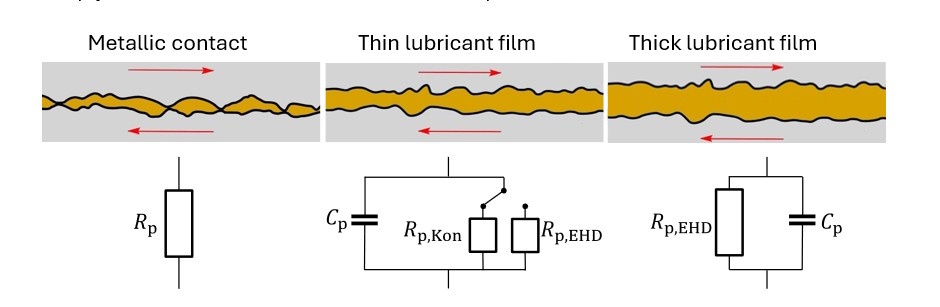
From an electrical engineering perspective, a bearing can be described surprisingly simply: as a combination of a resistor and a capacitor.
Under boundary lubrication conditions, direct metallic contact occurs, which electrically corresponds to a short circuit or ohmic resistance.
As the lubricant film develops, these direct contacts are increasingly interrupted. Instead, numerous small regions form in which the metallic surfaces are separated by lubricant. These regions behave like tiny capacitors.
In practical terms, this means that under mixed lubrication conditions, the electrical behaviour continuously alternates between conductive and insulating states. The bearing therefore behaves like a parallel circuit consisting of resistors and capacitors.
Only when the lubricant film is fully established and metallic contact no longer occurs does the bearing exhibit stable capacitive behaviour with high electrical resistance – a clear indication of hydrodynamic lubrication.
A key advantage of this measurement principle is its universal applicability to all bearing types made from metallic materials, rolling bearings and plain bearings.
Sensor Technology for Condition Monitoring and R&D
To better characterize changes in the lubricant film, HCP Sense has developed dedicated characteristic parameters. These parameters allow clear differentiation between boundary, mixed, and fluid lubrication conditions.
For users, this creates substantial added value: critical developments become visible at an early stage, long before actual damage occurs. At the same time, the collected data enables the definition of specific threshold values for safe operation – an essential basis for reliable machinery and optimized maintenance strategies.
The sensor technology proves its effectiveness every day in applications at numerous well-known industrial companies. Its use cases range from test benches and subsystem carriers to complete machines; from rolling and plain bearings to motors, hydraulic systems, transmissions, vehicles, woodworking machinery, and wind turbines.
Early Warning System for Pump Failures in Critical Infrastructure
Critical cooling pumps used in power grid infrastructure must operate continuously and reliably to ensure stable grid performance. To minimize the risk of unexpected failures, Hitachi Energy conducted a benchmark study comparing different condition-monitoring technologies for the early detection of lubrication- and bearing-related damage.
As part of the research project, the sensor technology developed by HCP Sense was evaluated against a conventional vibration-based OEM monitoring system using a single-stage centrifugal pump under realistic operating conditions.
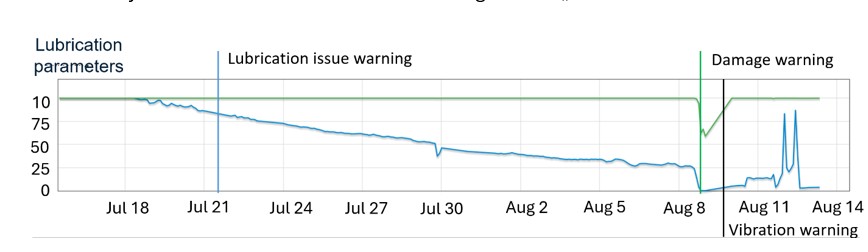
To compare the warning capabilities of both systems, a controlled endurance test was performed using reduced lubricant quantity and degraded lubricant quality in order to deliberately induce a lubrication-related bearing failure.
The results showed that the HCP Sense hydrodynamic lubrication parameter identified a developing lubrication problem approximately three weeks before the final bearing failure occurred. According to the study, simple corrective actions such as relubrication or minor operating adjustments would have been sufficient to prevent the damage entirely.
In the direct comparison, the HCP Sense mixed lubrication parameter detected the impending failure 24 hours earlier than the vibration-based monitoring solution. The test ultimately resulted in catastrophic bearing failure with cage fracture, as no intervention was intentionally carried out during the “run-to-failure” experiment.
Early Detection of Critical Lubrication Conditions in Engines
Plain bearings are among the most critical components in large combustion engines, as sudden bearing failure can lead to severe crankshaft damage and extended downtime. Particularly in medium- and high-speed engines, operators often have less than 60 seconds to shut down the system safely once critical operating conditions occur.
The technology was validated by MIBA on their plain-bearing test rig under static and dynamic load conditions. During controlled seizure tests, the characteristic parameter for mixed lubrication indicated increasing mixed friction up to 30 minutes before actual bearing seizure occurred. Under dynamic loading, the system also successfully detected lubrication breakdown during peak load conditions several minutes before catastrophic failure.
By detecting critical lubrication conditions at a very early stage, operators can intervene in time to prevent severe bearing and crankshaft damage, reduce downtime, and improve operational reliability.
About HCP Sense:
HCP Sense was founded in 2021 as a spin-off from the Chair of Machine Elements at the Technische Universität Darmstadt.
Based in Darmstadt, the innovative technology company specializes in the development of smart sensor solutions for monitoring lubrication conditions in mechanical engineering applications. The patented impedance measurement technology integrated into the bearing represents a milestone in condition diagnostics.