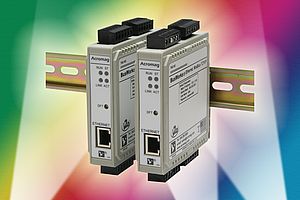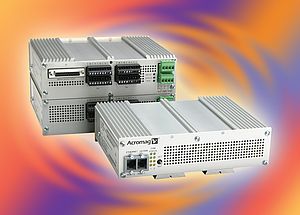



Acromag now offers a stepper motor controller in their BusWorks® NT Series of Ethernet I/O modules. The new NT2710 module provides six pulse train/logic outputs, six encoder inputs, and four general-purpose digital I/O for motion control applications with stepper motor drivers. A wide variety of commands are supported to precisely control the stepper motor position, speed and direction. Linear, triangular, and trapezoidal S-Curve acceleration/deceleration profiling reduces mechanical stress for smoother movements. Programmable controllers (PLCs/PACs) interface with the NT2710 module using Modbus TCP/IP, EtherNet/IP, or PROFINET network protocols. An OPC UA server, MQTT client, and RESTful API are also provided to support Industrial Internet of Things (IIoT) applications.
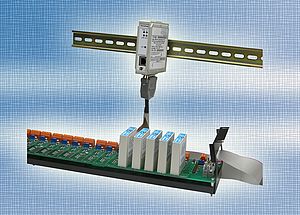
Integrated DIN rail bus for up to 64 channels over one IP address
NTE Ethernet models provide dual RJ45 ports for network communication plus the stepper I/O control channels. NTX expansion modules add extra I/O channels to control more motors or axes. Three NTX modules can link to the NTE communication module through an integrated DIN rail bus interfacing up to 64 channels over a single Ethernet IP address. A variety of signal processing functions are available on other NT Series analogue and discrete I/O modules, which can be combined to monitor or control voltage, current and temperature signals. Applications include machining, packaging, positioning, dispensing, printing, and many other industrial manufacturing operations. Motion control functions can now be integrated with data acquisition, status monitoring, on/off control, predictive maintenance, energy management, and many other requirements.
The BusWorks NT2000 Series offers a broad variety of I/O signal processing options. Sixteen I/O configurations are available as either NTE Ethernet I/O or NTX expansion I/O models. Analog I/O models feature up to sixteen inputs or eight outputs for monitoring and controlling current or voltage signals. Discrete I/O models provide sixteen tandem input/output channels or six mechanical relays to sense or switch on/off and high/low logic levels. For temperature measurement, thermocouple and RTD input models support many sensor types and ranges.