
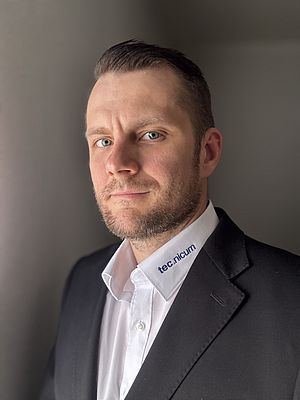
IEN Europe: Schmersal is a well-known name in the field of machine safety. tec.nicum, on the other hand, is probably less familiar to our readers. Could you please explain the connection between the two to our readers?
Ivanov: Most people in machine safety are familiar with Schmersal, known for providing safety devices, systems, and solutions for over 80 years. Its headquarters in Wuppertal, Germany, reflect a long-standing tradition of innovation and quality.
What many do not know is that tec.nicum is a subsidiary of the Schmersal Group, which focus on safety services. We set up tec.nicum because customers needed more than hardware. They needed help with staff training, risk assessments, CE marking, safety concepts, and retrofits. A safety switch only does part of the job. The rest depends on how a machine is designed, used, and maintained. Our engineers and consultants cover all of that — independently, neutral, without a sales agenda. In practice, we work with both machine builders and end users, often on projects where the two need to come to an agreement about responsibilities.
IEN Europe: In recent years, there has been an increasing focus on personal liability issues for directors and management in relation to (cyber)security. How widespread is awareness of this issue already, and is there still a need for further education and awareness-raising?
Ivanov: Awareness still varies significantly. Large companies with dedicated compliance and risk management functions generally have a structured understanding of cybersecurity obligations. However, in many mid-sized manufacturing companies, management often does not yet fully connect cybersecurity risks with their own personal liability — and that gap is becoming increasingly critical.
Under German and increasingly EU law, management has a clear duty of care for risk management, and regulations such as NIS2 are making cybersecurity responsibilities more explicit at the executive level. As a result, after serious cyber incidents, investigations are increasingly examining what management knew, when they knew it, and what actions they took.
This is why further education and awareness-raising remain essential. Our management workshops aim to provide clarity on legal obligations and practical steps — not to create fear, but to enable informed and responsible decision-making.
IEN Europe: How high is the general demand for advisory services on security issues in manufacturing? And how have EU regulations, such as the Cyber Resilience Act and the Machinery Directive, further altered or intensified this demand?
Ivanov: Demand has grown significantly in the past three years, driven by two factors: greater connectivity in production systems, and new regulations.
The new EU Machinery Regulation — applying from January 2027 — treats cybersecurity as part of machine safety for the first time. The Cyber Resilience Act goes further, requiring manufacturers to identify vulnerabilities, provide security updates across the product lifetime, and report serious incidents. For many manufacturers, this is unfamiliar territory. They are used to thinking about safety in terms of physical hazards — guards, interlocks, emergency stops. Now they must integrate cybersecurity into risk assessments and product development from the start. They know the general direction but need someone to translate regulation into concrete steps. That is where we come in.
IEN Europe: What other current trends do you see in the field of machine safety and safe production at the moment, such as IO-Link Safety? What solutions can you offer companies to help them stay up to date with the various requirements?
Ivanov: IO-Link Safety is one of the most practical developments in recent years. It transmits safety-relevant data over standard cables alongside process data, simplifying wiring, speeding up commissioning, and making fault diagnosis much faster. For a machine builder, that means fewer components and less downtime.Alongside this, we see another important trend such is the growing use of collaborative robotics, which demands new safety strategies for human-machine interaction beyond traditional guarding. In parallel, digitalization and data-driven safety are enabling better diagnostics, predictive maintenance, and more transparent safety management throughout the machine lifecycle.
IEN Europe: What key trends and developments do you anticipate in industrial production over the next few years? What impact will the integration of humanoid robotics have, for example? How do you assess progress in the harmonisation and simplification of international standards?
Ivanov: Humanoid robots are the development we watch most closely. Collaborative robots have already challenged the traditional assumption of strict separation between human and machine. Humanoid robots take this further — moving through a factory, handling a wide range of tasks, working directly alongside people. Existing robot safety standards were not written with this in mind. Manufacturers who deploy them now must carry out detailed risk assessments that go beyond what current standards explicitly require.
On harmonisation: progress is real but slow. Within Europe, the shift from directives to regulations reduces variation between member states. Global harmonisation remains difficult. A manufacturer selling into both EU and North American markets still faces meaningfully different regulatory environments. Our practical advice: design to the most demanding applicable standard, document thoroughly, then identify which specific requirements apply per market.
Longer term, we expect safety to shift from something designed in once to something monitored in real time. Operational data already makes it possible to detect early signs of wear or unsafe behaviour before an incident occurs. That is the direction. The fundamental goal, though, remains unchanged: helping people work safely with machines.
IEN Europe: Thank you for these insights!
Company Info:
tec.nicum – Solutions & Services GmbH, offering risk assessments, safety concepts, CE marking support, safety retrofits and specialist training. The company comprises a global consultancy network of TÜV Rheinland-certified Functional Safety Engineers and Machinery CE Experts. Services can be called upon around the world. tec.nicum’s core philosophy is to offer advice that is independent of manufacturers and as objective as possible.