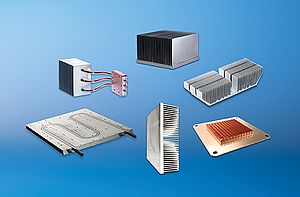



Four factors are crucial for a cooling solution. The first is heat dissipation. Secondly, the heat sink should have a lightweight design to reduce the load on the component. Thirdly, it must be as small as possible. The last factor to consider is the price-performance ratio. Based on these factors, as well as the material, design, and manufacturing method, heat sink manufacturers like CTX create high-quality heat sinks with added value.
Now is the time to change a running system
For example: The temperature of a sample system needs to be ten degrees lower. This is possible without changing the size of the component. Thermal management in this sample component is based on the classic extruded profile heat sink used in the cooling of power electronics. Its design consists of a base plate that is connected to several closely arranged fins. This creates a large overall surface for heat transfer.
Now we have to determine: How much heat is dissipated by the base plate? At which point do the fins take over the transfer of heat? A design that makes full use of the base thickness is beneficial in reducing the temperature. In our example, changing the base thickness from 11 to 14 millimeters improves cooling by about 1.7 °C.
The second point to consider is the number of fins. CTX uses extrusion for the economical production of aluminum cooling fins in large quantities. They can be designed for the exact cooling requirement by means of a forming tool. This reduces material by 20 percent compared to standard components. In our example, the result is thinner fins. This increases the number of fins by ten without changing the size of the base plate. The overall temperature reduction is now 3 °C.
How to make efficient use of installation space
Further potential for optimization is possible by looking at the heat generation of the component. What are hot spots? Where are surfaces with lower heat generation? The cooling concept of a heat pipe can be used to precisely control the heat flow. A heat pipe consists of a closed copper tube system with an internal capillary structure. In this system, a coolant absorbs large amounts of heat at the hot spot, then conveys it to the heat sink, where it is discharged in the form of condensation. Copper, with up to 400 W/mK, has higher thermal conductivity than aluminum at 210 W/mK. Since it is much heavier and more expensive, however, it is mostly used as a coating, plate, or core. In our example, the combination of aluminum extruded profile heat sink and heat pipe achieves the target value: The cooling capacity of the thermal concept is now 9.9 °C below the starting temperature.
As miniaturization progresses, custom solutions will continue to gain in importance.