

That excess doesn’t only impact the specification sheet. It can add cost, weight and inertia, expand the bill of materials, complicate configuration and increase the number of parts to be stocked and supported. As well as this, it may also create work elsewhere, from thermal management and safety validation to software setup and commissioning.
Multiply those effects across dozens of axes and things become very noticeable, and what felt like a modest safety margin ends up as a significant engineering and financial burden.
Of course, the alternative is not to strip every system back to its cheapest possible form, but to specify each axis with the same care used to design the motion profile itself.
The hidden cost of “just in case”
Over-specification is often driven by uncertainty. Machine requirements may change during development, customers may request future variants, and engineers want to avoid discovering too late that a component is undersized or underpowered. The difficulty is separating useful headroom from unused capability.
An oversized motor may add mass and inertia to the mechanism it must move. A specialist feedback option can introduce extra interfaces, part numbers or setup work. A drive packed with functions that the application never calls on may still demand time to configure, document and validate. Customized products can also increase lead times while making spares and long-term service costlier and harder to access.
Energy use is another consideration. Pursuing maximum performance or efficiency at every possible operating point can increase cost and complexity without producing a proportionate return in the real application. These additional costs are easy to miss because they do not all appear in the component price, but emerge through engineering hours, larger inventories, delayed commissioning and more challenging maintenance. That is why right-sizing should not be seen as a simple cost-cutting exercise. Rather, it is a key piece of engineering, designed to keep the machine focused on what it must achieve.
Start with the work the axis must do
Right-sizing begins as soon as specification does, and a good place to start is by looking at each axis separately.
After all, a machine may contain many servo axes, but they rarely face identical demands. One may control a cutting head that requires tightly synchronized motion. Another may index a product between stations. A third may operate a diverter gate or adjust the position of a guide.
Using the same top-end motion package for all three may simplify an early purchasing decision, but it rarely produces the best machine. Instead, good specification begins with the axis rather than the product catalogue.
How much continuous and peak torque does it require? At what speed and duty cycle? How closely must it coordinate with other axes? Does it need high-speed registration, absolute position after a power loss or only repeatable point-to-point movement?
This axis-by-axis approach preserves a sensible engineering margin without turning every possible future requirement into a design rule. Vitally, it also recognizes that specialist technology still has an important place – a demanding direct-drive axis, severe environment or unusual mechanical envelope may genuinely justify the use of a highly customized solution. Choosing advanced motion is not a bad thing when needed but treating it as the default can cause problems.
From selected components to a working system
Once the requirements are clear, engineers still face another challenge: the motor, drive, feedback device and cabling must operate as a coherent system.
A collection of individually suitable components does not guarantee easy integration. Someone must confirm the electrical and mechanical interfaces, load the right motor data, configure communications, tune the axis and establish that everything performs as expected.
This is where pre-matched and validated motion systems can deliver real value. They retain the benefits of right-sized components while reducing the engineering work needed to turn them into a functioning axis.
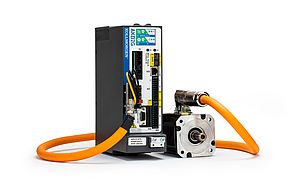
The Kollmorgen Essentials system was developed around this idea. Each system combines a performance-matched servo motor and drive with integrated multi-turn absolute feedback and a combined power and data cable. The range covers common industrial power requirements while avoiding the configuration options associated with fully customized motion.
The aim is not to remove engineering choice, but to focus decision-making where it adds value. Motors and drives from the system are selected from a curated set of sizes and performance options intended to address the requirements of typical industrial axes. More specialized systems remain available for applications with unusual performance, mechanical or environmental demands, and all can operate within the same wider motion ecosystem.
This range is not a universal replacement for advanced motion technology. Rather it gives machine builders a practical way to deploy the best technology for each axis.
Reducing work around the motion task
The benefits of a matched system extend beyond initial selection. Single-cable technology reduces the number of cables and connections that must be routed and checked. Motor parameter data and guided setup tools can also reduce manual configuration and tuning work.
Communication flexibility matters too. Drives capable of supporting common protocols such as EtherCAT, EtherNet/IP and PROFINET allow the same core platform to operate with several controller environments. For machine builders supplying customers in different industries or regions, this can reduce the need to maintain separate drive variants and bills of materials.
These features do not make the axis more powerful in the traditional sense. Instead, they make selection clearer, reduce the interfaces needed for installation, and give machine builders confidence that the combination is designed and validated to work together.
Applying performance where it creates value
A well-designed machine does not need every axis to use the same level of technology. Rather, it needs each axis to perform its role reliably while contributing to an architecture that remains practical to build, commission and support.
The same logic applies throughout machine design. Use specialist protection where the environment demands it, premium feedback where extreme accuracy is required, and high-end torque density, customization and control where they produce a measurable machine benefit.
The best-engineered machine is not the one that uses the most advanced component at every opportunity. It is the one that knows where advanced performance matters, where standardized motion is sufficient, and how to bring both together without unnecessary effort.