

With conventional maintenance strategies, generous buffers are unavoidable. It is better to replace a bearing three months too early than one hour too late. Nevertheless, there is no guarantee that a critical element will not fail. Minimal assembly errors and unexpected impacts from external mechanical forces can trigger what you wanted to avoid at all costs: unplanned downtime and its costly consequences.
Sensors for Real-Time Monitoring
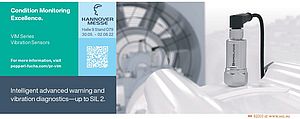
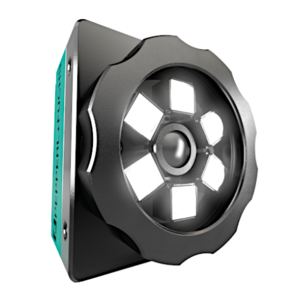
Intelligent, networked sensor systems can be used to monitor plant components that require maintenance in real time. For example, vibration sensors can detect vibration patterns that change under the influence of wear, increasing contamination, and other influences. The evaluation of the sensor data provides a detailed and up-to-date picture of the actual condition, including a data-based calculation of the expected remaining service life. This not only enables proactive maintenance, but also predictive maintenance.
In addition to the vibration patterns of shafts and bearings, many other parameters can be monitored using appropriate sensors. Temperature values and curves can also indicate mechanical changes; changes in pressure values allow early detection of leaks and sealing problems; flow measurement, in combination with other data, can provide information about the condition of pumps, valves, and piping systems.
Digital Twin for Precise Maintenance
The decisive factor now is the intelligent combination and evaluation of all relevant data. A digital twin makes this step particularly efficient, as it provides a virtual representation of the physical system in real time and with a high level of detail. With targeted implementation, it becomes the central basis for predictive maintenance. It is therefore often incorporated into new systems from the outset. However, if you also want to take advantage of its benefits in existing systems, there is no way around retrofitting.
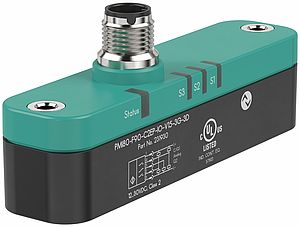
The principle of "never change a running system" is a sum of financial, technical, and psychological factors. All three are taken into account in the Starter Kit concept from Bosch Digital Twin Industries and Pepperl+Fuchs. Its aim is to make the integration of a digital twin as simple and cost-effective as possible, including in existing systems. The user not only receives a complete package conceptually, but also physically: In a compact cardboard box, they will find a powerful 12 kHz vibration sensor that performs condition monitoring on a moving machine part, an ICE2 or ICE3 IO-Link master, and a BTC22 embedded PC from Pepperl+Fuchs.
Plug and Play
These components are simply installed according to the supplied wiring diagram and connected to the network. As soon as the power is switched on, the system configures itself. The vibration sensor transmits its measured values to the IO-Link master, which forwards them to the Box Thin Client BTC22 for pre-processing and aggregation. This fanless computer also acts as an edge gateway and is designed for robust industrial use.
After a short teach-in phase, it transmits the processed data to the so-called "Intelligence Core", Bosch's digital twin platform. The digital twin analyzes and processes the collected system data to create a clear status picture from which options for action can now be derived. A simulation model with the IAPM tool (Integrated Asset Performance Management) enables real-time analysis, which is based on established cloud platforms such as AWS or MS Azure and also uses machine learning algorithms and artificial intelligence.
Customization and Scaling
The data can also be called up on the dashboard in the browser. Existing and future mechanical problems are visualized in detailed 3-D models. The evaluation software calculates remaining running times and offers differentiated predictions of predictable failures. This makes it possible to plan maintenance based on the condition of the system and actual requirements. At the same time, the evaluation can be used to further optimize processes. If a threshold value is exceeded or a critical situation occurs, a corresponding notification can be sent as a push message by email, text message, and other communication tools to specified recipients.
As a modular system, the Digital Twin Starter Kit can be individually adapted to the requirements of the respective system and scaled up as needed. Experts from Bosch Digital Twin Industries and Pepperl+Fuchs support users with coordinated advice on custom-fit integration and upgrades in line with IIoT and Industry 4.0.