


In many applications, harsh ambient conditions present a significant challenge for sensor technology. In such cases, ultrasonic sensors that are largely unaffected by physical influences become especially valuable. They operate equally reliably in dusty storage bunkers and weather-tested outdoor areas as they do in demanding industrial facilities. The UB*-F42 sensor series from Pepperl+Fuchs combines this inherent durability with IIoT communication through an integrated IO-Link interface. In addition to delivering precise measurement and switching signals, these sensors provide detailed process and status data – supporting diagnostic, system optimization, and condition-based maintenance strategies.
The metrological core of the ultrasonic sensor is a piezoceramic transducer that generates short sound pulses using a membrane. The same membrane detects the echo that is reflected back from the target area. The integrated electronics calculate the distance value from the time span between transmission and reception.
Objects with changing colors, as well as reflective or transparent surfaces that can often interfere with optical sensors, have no impact on the measurement results. The technology is equally resistant to dust, fog, moisture, and buildup from adhering dirt. In addition, the sound waves propagate in a cone-shaped beam, covering a broader area rather than a single point. This allows irregular, perforated, or broken contours to be detected reliably. Because the measurement principle is non-contact, there is no mechanical wear.
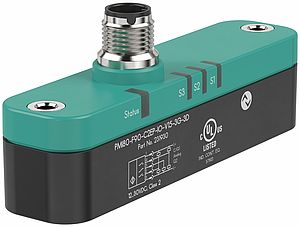
Additional benefits on a proven basis The UB*-F42 series builds on a technical basis that has been established and continuously developed over many years. The housing with IP67 degree of protection is resistant to dust and moisture, making it suitable for outdoor applications and areas with frequent cleaning. Compared to previous versions, the connectors feature a metal housing designed for maximum strength. The dimensions and installation devices remain unchanged so that the devices can be integrated into existing installation concepts; adapter plates are available for replacing concept-identical K0 devices.
A key strength of the new generation of devices is their communication capability. Their IO-Link interface enables remote access to all sensor parameters. In addition to the measured values, it provides additional information such as operating hours, temperature, or device status. Such data increases transparency at the field level and can be specifically evaluated by higher-level systems. For example, significant temperature trends or status changes can be detected early and incorporated into maintenance plans. The sensor technology supports condition-based maintenance and helps reduce unplanned downtime.
Switching outputs and IO-Link combined
Process data and status information can be seamlessly integrated into the automation architecture. From sensor configuration via IO-Link tools to visualization in HMI/SCADA systems, measured value, status, and key operating figures can be consolidated. This makes sensor technology not only the source of a signal, but also a building block for traceable operational maintenance decisions – for example, when maintenance is planned based on solid data or limit values are adapted to changing products.
The combination of the IO-Link interface with two push-pull outputs is a unique feature of the UB*-F42 series. This means that two switch points can be used in parallel while IO-Link communication is available at the same time. In practice, a single sensor technology can perform two tasks, for example by reporting the "empty" and "full" limit levels in a fill level application and providing additional information at the same time. This not only reduces the number of components required, but also reduces the installation effort and wiring. At the same time, configuration remains flexible so that switch points and other settings can be adapted to the application. A teach-in input is also available for commissioning, which enables teach-in without push buttons; operation is therefore also possible without IO-Link.
Customized for specific applications
The devices in the series are available with measuring ranges from 500 mm to 6000 mm. For short detection ranges, there are sidelooker variants in which the ultrasonic transducer in the housing is rotated by 90 degrees. This lateral arrangement of the sound membrane allows installation in confined spaces. As the dead band of the devices is especially short compared to other devices on the market, the usable measuring range in such compact structures is significantly increased.
The shape of the sound beam can also be configured to adapt to the environment. A wider beam is suitable for area monitoring or irregular structures; a narrower alignment of the sound waves minimizes the interference echo in narrow containers or with complex geometry. If several sensor technologies are operated in close proximity, a synchronization function supports interference-free parallel operation. After connecting the synchronization inputs, up to ten devices can work side by side without their sound pulses influencing each other.
From the building material bin to the material roll
The combination of robust principle of measurement, high degree of protection, and digital communication opens up a wide range of applications. In silos and tanks, UB*-F42 sensors detect the fill level of liquids just as reliably as that of granulates or bulk materials. Dust formation and vapors do not impair measurement. For bulk solids, the surface-wide detection of the material cone can be used to establish a stable average value. In open storage areas, the weather-independent measuring principle together with the IP67 housing ensures consistently reliable detection.
For access and exit control at gates and entrances, the sensor technology detects vehicles regardless of their color, contour, or reflective surfaces. Even wet or dirty environments, such as in car washes or on construction sites, are tolerated without any problems. In production systems that process roll material such as paper, film, or sheet metal, the device measures the decreasing roll diameter and therefore the material consumption. When a defined limit value is reached, replenishment can be requested automatically. Here too, harsh conditions such as dust formation, oily build-up, vibration, or high temperatures play virtually no role in measuring stability. As the same sensor type can cover different tasks, integration costs and spare parts stocks are significantly reduced.
Hannover Messe 2026 Exhibitor: Hall 27, D38