


For the coffee shop, the task is to draw the exact dose of water required to produce the full richness of a perfect cup of espresso. For the pub or bierkeller, it is serving exactly a half-liter of weissbier so that the customer gets no more and no less than they paid for. And for the industrial process control engineer, the requirement is to know exactly when a filter has cleaned its rated volume of water and is due for replacement.
In all these applications, accurate flow sensing can substantially increase the value of equipment or machinery. Traditional electromechanical technology for flow sensing has, however, been a pain point for system design engineers, causing performance and reliability headaches which have proved difficult to eradicate.
Pure electronic sensing using ultrasonic technology eliminates the moving parts from a flow sensor assembly, and provides an escape route from the problems with traditional flow sensors. When first introduced, ultrasonic sensor ICs posed a considerable integration challenge which generally restricted their use to the manufacturers of specialist measurement equipment.
But now successive generations of complete off-the-shelf ultrasonic flow sensing modules, which provide a simple measurement interface to any microcontroller, have made accurate, reliable ultrasonic flow sensing a valid option for non-specialist designers of any type of equipment which can benefit from flow rate measurement.
Stuck with traditional turbine-based flow sensors
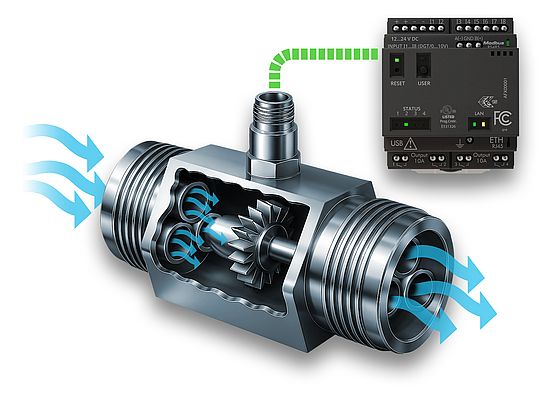
Traditionally, flow sensing has been performed using a simple electromechanical assembly comprising a length of tubing containing turbines, which is positioned inline with the flow (see Figure 1). The speed at which the turbines rotate can be converted into a measurement of the flow rate. Over time, these measurements can be integrated to provide an absolute measurement of the volume of liquid that has passed through the sensor.
This method of sensing flow provides a simple measurement interface to an external logic device such as a microcontroller or programmable logic controller (PLC). But equipment manufacturers have to take account of serious drawbacks which can limit the sensor’s usefulness, or even make the sensor inoperable. The problems stem from inherent mechanical characteristics of the turbine or wheel in the assembly.
The first problem is that a turbine has friction which creates inertia: at low flow rates, the force of the flow will be insufficient to overcome the turbine’s inertia, and so the turbine will fail to rotate. As a result, a low flow rate will be registered as zero flow. Part of the value of many applications for flow sensing is the ability to measure leakage – in other words, a fault condition in which the flow is continuous, but at a much lower rate than in normal operation. In this case, an electromechanical flow sensor will be able to measure normal flow, but will likely fail to alert the operator to leakage.
The second problem with turbines is catastrophic failure: the turbine is a moving part, and so can become corroded or broken. Reliability is a key issue for users of flow sensors: mechanical flow sensors suffer from wear and tear which limit their operating lifespan.
Ultrasonic flow sensing technology eliminates moving parts
If the problem is the presence of a mechanical component in the flow to be measured, then the solution is to measure flow contactlessly. This can be accomplished by ultrasonic sensing technology.
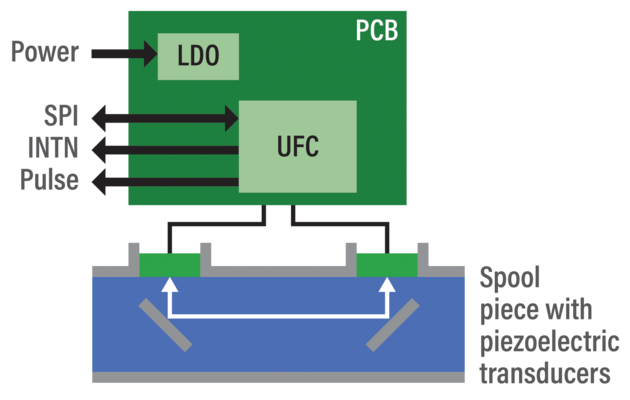
Ultrasonic flow sensors measure fluid flow rate by transmitting sound waves through the flowing medium via paired transducers positioned diagonally across the pipe. One transducer sends ultrasonic pulses downstream while the other sends them upstream. The flowing fluid affects propagation speed: downstream pulses travel faster (aided by the flow) while upstream pulses travel more slowly (impeded by the flow). Flow velocity is directly proportional to the difference in transit times between these paths.
This non-intrusive measurement technique works with clean liquids and gases, has no effect on the flow medium itself, and scales across various pipe diameters. Crucially, it also eliminates the drawbacks of turbine-based mechanical flow sensors. The absence of moving parts inside the flow medium means that the sensor offers a practically unlimited operating lifespan, and can also measure extremely slow flow speeds.
Implementation of this method of flow sensing calls for extremely accurate measurement of the small-time differences between downstream and upstream sound transmission – a phenomenon measured in picoseconds.
In fact, the entire time signal-processing function may be implemented by an ultrasonic flow converter IC from ScioSense. This highly integrated device, shown as the ‘UFC’ block in Figure 2, triggers the twin transducers, measures the time difference between the return signals, and converts the measurements to a flow rate and accumulated volume data for any given pipe diameter.
Key design considerations in ultrasonic flow metering
To integrate an ultrasonic flow converter (UFC) into a flow sensor system, the designer has to take account of various considerations which affect the operation of the technology. These include:
- The transducer mounting geometry.
- The acoustic properties of the pipe material - metals, plastics, and composite pipes each have different acoustic impedances and attenuation characteristics. Wall thickness, surface finish, and coatings can reflect or absorb acoustic energy. The acoustic path must also account for refraction at material boundaries.
- Temperature variation - sound velocity in fluids varies significantly with temperature. For instance, the speed of sound in water varies by approximately 0.6%/°C.
Off-the-shelf modules provide ready-made solution
Specialists in flow measurement system integration, such as water utility meter manufacturers, maintain internal design expertise to enable the integration of a UFC into a custom flow sensor assembly, taking account of the factors listed above.
But the wider application of flow sensing has value in a broad range of other types of equipment. Examples include:
- Coffee brewing machines,
- Beverage dispensers,
- Water purifiers,
- Water heaters, boilers and heat pumps,
- Irrigation systems,
- Cooling machines,
- Industrial process control systems and filters,
- Livestock feeding equipment.
In these applications, flow sensing is a peripheral rather than a primary function, and so here OEMs typically prefer a ready-made, off-the-shelf ultrasonic flow sensing solution which dramatically reduces design time and effort and accelerates time to market.
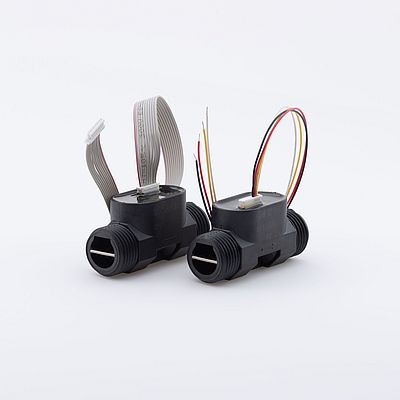
Complete ultrasonic flow sensor modules meet this market need. ScioSense is a pioneer in this market, offering first the UFM-01 and, in 2025, launched an improved version, the UFM-02. The advantage of a modular solution is that it is extremely easy to integrate into end equipment designs. In the case of the UFM-02, for instance, the module is available in two thread sizes: 0.5” and 1”, each provided in either a BSPP (British Standard Pipe Parallel) or NPS (American National Pipe Straight) format. Two more thread sizes, 3/8” and1.5”, will be available soon. The smallest thread size manages a maximum flow rate of 20l per minute, and the largest, up to 450l per minute.
he module is highly sensitive to slow liquid flows, allowing the sensor to accurately detect leakage. In its smallest, 3/8” thread size, the UFM-02 can measure flows as slow as 0.03l per minute.
The UFM-02 is also easy to interface to any microcontroller or PLC. The module is available with a choice of two cable connections. A four-wire pulse interface cable provides a simple output signal with up to 450 pulses per liter and a 10-wire SPI cable which provides digital data including total volume of liquid flow in cubic meters, filtered flow rate in liters/hour, and a measurement of the liquid’s temperature.
An important development in the second-generation UFM-02 module is its power consumption, which is substantially lower than in the UFM-01. Average operating current has been reduced to 50µA, low enough to enable applications to run for years on a standard primary battery.
The introduction of this latest module means that a drop-in solution for ultrasonic flow sensing can now be implemented in applications which cannot easily be connected to a mains or other external power supply and so rely on battery power.
Module manufacturer with a long heritage in ultrasonic flow sensing
Ultrasonic flow sensing provides a reliable, accurate and sensitive alternative to traditional mechanical flow sensing. By using a modular off-the-shelf sensing assembly, OEMs can take advantage of these qualities of ultrasonic technology in a solution which is easy to integrate into an electronics system.
Designers who evaluate the latest UFM-02 module can also take confidence from the long heritage of ScioSense, a company which introduced its first ultrasonic flow converter IC more than 25 years ago, and which can offer customers deep expertise in every aspect of the implementation of ultrasonic technology for flow measurement.