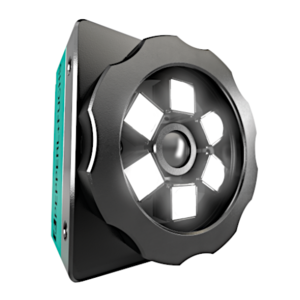


CleverReader is a camera-based sensor that recognizes all common 1-D and 2-D codes. It enables reliable performance even on reflective surfaces and displays. The base model VOI1000 provides reliable identification data for stationary objects. For more challenging applications, the VOI1100 version is available, which can read codes even when they are moving very quickly.
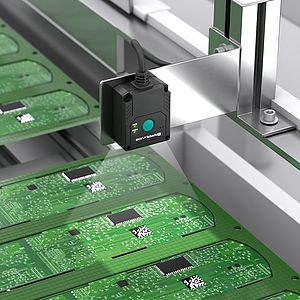
This sensor not only reads adhesive labels but also DPM codes stamped onto metal objects in the automotive industry, as well as laser-etched DPM codes. The latter are used, among other things, in microelectronics to mark printed circuit boards. The CleverReader VOI1100 can also read very small codes on printed circuit boards.
A key factor behind this strong reading performance is the sensor’s exceptional depth of field. At 55–460 mm, the VOI1100 achieves a value that surpasses all other devices in this price range. Within this distance range, the sensor reads the codes without any adjustment to the optics.
Triggers and Reading Modes
Code reading can be triggered by external triggers or automatically. Five different reading modes are available, covering all common application scenarios: In Pulse Mode, a defined trigger activates reading for a specified duration. This can be a signal from the controller or another sensor. In Level Mode, scanning occurs continuously as long as the trigger is active until a code is read. Reading begins as soon as the trigger sensor’s light beam is interrupted. It detects the code regardless of its position on the object. This ensures reliable reading even with high variability on the conveyor belt, such as in package logistics. In Continuous Mode, the trigger is permanently activated. In Sense Mode, reading begins without an external trigger in response to movement within the detection range. For example, you can hold a code in front of the sensor to trigger a subsequent process—such as requesting a specific medication in a pharmacy stock based on a prescription. The sensitivity is adjustable. In Multiple Session Mode, the code reader behaves similarly to Level Mode. Unlike Level Mode, however, it can read multiple different codes on the same object.
Easy Access
CleverReader sensors are designed for easy setup and operation. They can be configured using control codes directly on the device or via the intuitive graphical user interface of the CleverReader Configurator. The SCAN button allows you to trigger a read even without a PC connection; the read is confirmed by an audible signal. The result can be verified on the screen in the Configurator.
The integrated Matchcode function automatically compares scanned codes with either a previously programmed code or a reference code specified by the controller. The device checks for both complete and partial matches, and enables the differentiation of various pieces of information stored within a single code.
Faulty codes and incorrect assignments are reported immediately. Production can be stopped before scrap is produced; the sensor output can trigger control and corrective process steps. Unlike simple code scanners, the camera-based sensor can save an error image if a code is damaged, obscured, or incomplete and therefore cannot be recognized. This supports root cause analysis and ensures traceability for the quality process.
Toolbox for Intuitive Operation
The intuitive parameterization interface minimizes the need for customization. Using a toolbox, the formatting of the output string can be “clicked together”; configuration is easily handled via drag-and-drop. A live simulation allows you to verify whether the code content is read and transmitted as intended. This ensures that the data can be transferred to higher-level systems, including ERP, with the appropriate formatting. The data is available for further processing in downstream processes without any additional steps, significantly reducing integration effort.
Thanks to the device’s compact design, this also applies to the mechanical side: at 24.3 × 41.5 × 49.5 mm, its dimensions are only slightly larger than a matchbox. It connects via an RS-232 interface using a 24 V/5 V converter cable. The cable handles both power supply and signal transmission and is available in various versions: with open cable ends or with DB9, M12, and M8 connectors. The latter allows for the direct connection of a trigger sensor. When used with a Device Master gateway from Pepperl+Fuchs, the sensor can be integrated into a fieldbus environment.
Versatile Applications
CleverReader sensors provide a solid foundation for identifying and tracking objects throughout the process. With reliable code capture, customizable parameterization, space-saving design, and a wide range of functions, they are suitable for many different applications. At the same time, the sensor family offers a price-performance ratio that is unique in this product category.
A typical area of application is intralogistics, where the demand for detailed information is increasing and 1-D codes continue to be replaced by 2-D technology. Here, CleverReader devices play a central role in controlling material flow. Flexible code reading enables the detection of objects, packages, containers, and transport units regardless of their position on the conveyor belt. Multiple codes on a single object are processed reliably. While 1 m/s is already considered a fast conveyor speed in this sector, the CleverReader VOI1100 can read codes at speeds of up to 3.5 m/s, thus providing a substantial safety margin.
CleverReader also supports precise identification processes in microelectronics. In this field, printed circuit boards are often marked with very small laser-etched DPM codes. The code reader reliably captures these markings as well, enabling both seamless process control and end-to-end product traceability.