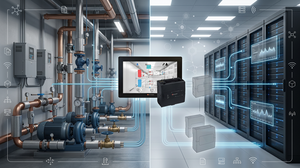


How can standardized machine data create real value for manufacturing, engineering, and digital business models? VDMA Machine Information Interoperability (MII) will provide answers at SPS 2026 in Nuremberg. At Booth 238 in Hall 5, companies and partner organizations will present several live demonstrations showing how open standards based on OPC UA Companion Specifications provide the foundation for seamless interoperability, AI applications, data spaces, and the next generation of digital production systems. Visitors will experience firsthand how these technologies interact in industrial environments and the benefits they create.
"The industry frequently discusses AI, data spaces, and the Digital Product Passport. However, the fundamental prerequisite is often overlooked: interoperable machine data. This is precisely the foundation that we are making visible and tangible at SPS through concrete demonstrations," explains Andreas Faath, Head of Machine Information Interoperability at VDMA.
Standardized Weighing Technology as a Building Block for Plug & Produce
Systec, Siemens, and Mettler Toledo will demonstrate how new devices can be integrated into production environments within a very short time and without complex, custom integration efforts. The demonstrator showcases the cross-vendor provision and use of integration and measurement data based on standardized OPC UA information models. Visitors will gain direct insight into how OPC UA Companion Specifications reduce integration effort while increasing the reusability of software solutions.
New devices can be commissioned significantly faster because the same semantic information models can be used regardless of the manufacturer. The real value is not created by data transmission alone, but by a shared understanding of the data. Standardized information models provide the foundation for devices from different manufacturers to be immediately understood and utilized.
Data Spaces: When Machine Data Crosses Company Boundaries
The international data space demonstrator shows how machines can be connected to industrial data spaces through standardized interfaces, enabling communication across company boundaries. Building on developments from projects such as SM4RTENANCE and Factory-X, the demonstrator illustrates how production data can be exchanged securely, sovereignly, and interoperably between companies without losing control over proprietary data.
Visitors will experience how OPC UA Companion Specifications combined with the Data Space Protocol (DSP) enable machines to communicate through data spaces with minimal effort. The demonstrator also provides insight into what a data-driven economy could look like in practice. Specific use cases include real-time energy data monitoring and the calculation of a Product Carbon Footprint (PCF), which is subsequently stored in an Asset Administration Shell (AAS).
Edge AI in Manufacturing
Artificial intelligence is increasingly becoming a productive tool for industrial applications. The AI demonstrator at the VDMA MII booth shows how generative AI can be run locally on industrial hardware. Sensitive production data remains entirely within the company. The solution demonstrates in a practical way how AI systems can communicate directly with machines via OPC UA, interpret machine data, and use it for analytics or software development tasks. Visitors will gain insight into future human-machine interactions in which open standards and AI technologies work hand in hand.
UaGuide Supports Practical Implementation
The portfolio is complemented by UaGuide. UaGuide supports companies in the practical implementation of OPC UA Companion Specifications. By validating information models and node structures at an early stage, errors can be identified and corrected during development.
This shortens development cycles and helps accelerate the delivery of interoperable solutions. "With UaGuide, we provide a simple and practical approach to implementing OPC UA Companion Specifications. Developers can validate their information models at an early stage and identify errors during development. This accelerates the implementation of interoperable solutions and helps companies create digital value networks more efficiently," says Marc Schmitt, VDMA Project Manager for UaGuide.